
Knee Replacement Wear and Implant Loosening in Hauts-de-Seine
Knee Surgery
What Is Knee Replacement Wear or Implant Loosening?
Dr Simon Tournemine in Hauts-de-Seine (92)
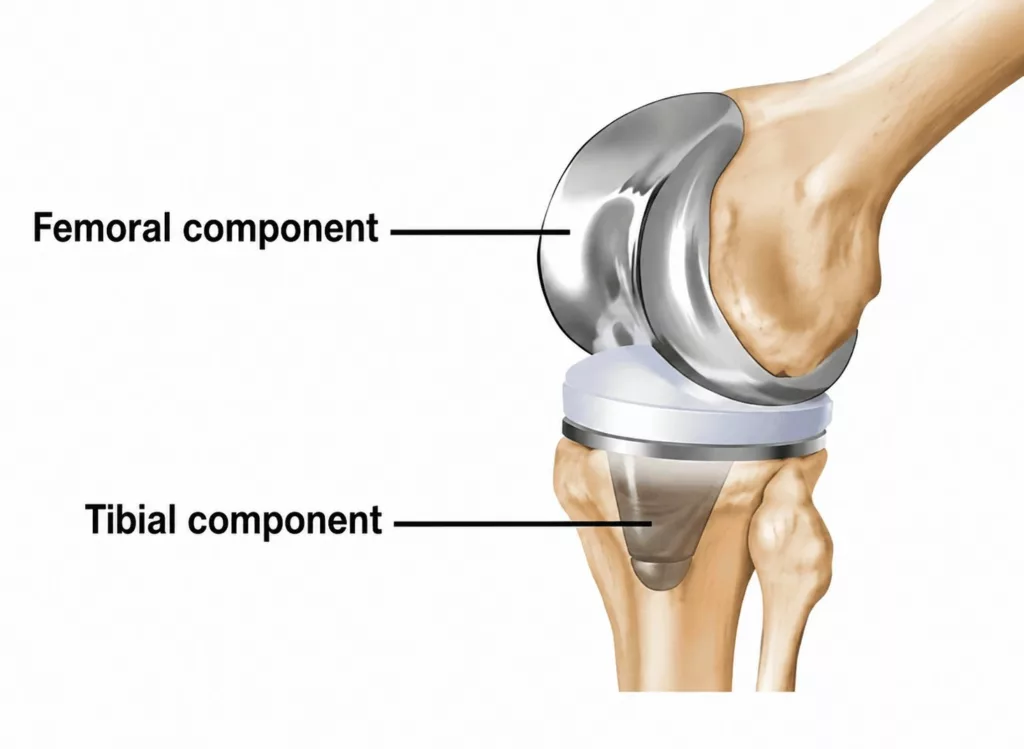
Several types of knee replacement are available, including total knee replacement, unicompartmental (partial) knee replacement, and patellofemoral knee replacement. These prostheses consist of mechanical components designed to reproduce the normal anatomy and function of the knee joint, including a femoral component fixed to the femur, a tibial component fixed to the tibia, and, when indicated, a patellar component attached to the kneecap.
Over time and with regular use, these prosthetic components may gradually wear or lose their fixation within the bone, a process known as implant loosening. Modern knee replacements generally have an expected lifespan of around 20 years, although older prosthetic designs may deteriorate more rapidly.
Causes and Risk Factors for Knee Replacement Wear and Implant Loosening
Knee Surgery Specialist in Hauts-de-Seine (92)
The gradual onset of pain affecting the knee or lower leg in a patient with a knee replacement should always raise the possibility of implant loosening. As the prosthesis deteriorates, its functional performance progressively declines, leading to increasing pain, clicking sensations, limping and, in some cases, episodes of instability or the feeling that the knee is “giving way”.
Although wear and loosening are among the most common causes of failure in knee replacement surgery, persistent symptoms may also result from prosthetic malposition, instability or infection. A thorough assessment is therefore essential to determine the exact cause of the problem and establish the most appropriate treatment.
Knee Replacement Wear and Implant Loosening in Rueil-Malmaison
Knee Surgery in Hauts-de-Seine
Diagnosis of Knee Replacement Wear or Implant Loosening
Accurate diagnosis is essential to determine whether the entire prosthesis requires replacement or whether only one of its components needs to be exchanged.
Clinical examination allows the surgeon to identify the precise location of the pain, review the previous surgical approach, assess the condition of the surgical scar, evaluate knee mobility and measure muscle strength.
Standard knee X-rays are routinely performed and frequently provide reliable evidence of implant wear, loosening or malposition. A CT scan may also be required to obtain a more detailed assessment of the bone surrounding the prosthesis, evaluate the degree of implant wear and accurately analyse the position of the prosthetic components.
A knee joint aspiration is often performed to obtain synovial fluid for microbiological analysis in order to exclude prosthetic joint infection.
Treatment of Knee Replacement Wear or Implant Loosening
When implant loosening or significant prosthetic wear is confirmed, surgical replacement of the affected component(s) becomes necessary. This procedure is known as revision knee replacement surgery, during which the worn or loosened prosthetic components are exchanged to restore knee function, relieve pain and improve joint stability.