
Achilles Tendinopathy in Hauts-de-Seine
Ankle Surgery
What Is Achilles Tendinopathy?
Dr Simon Tournemine in Hauts-de-Seine (92)
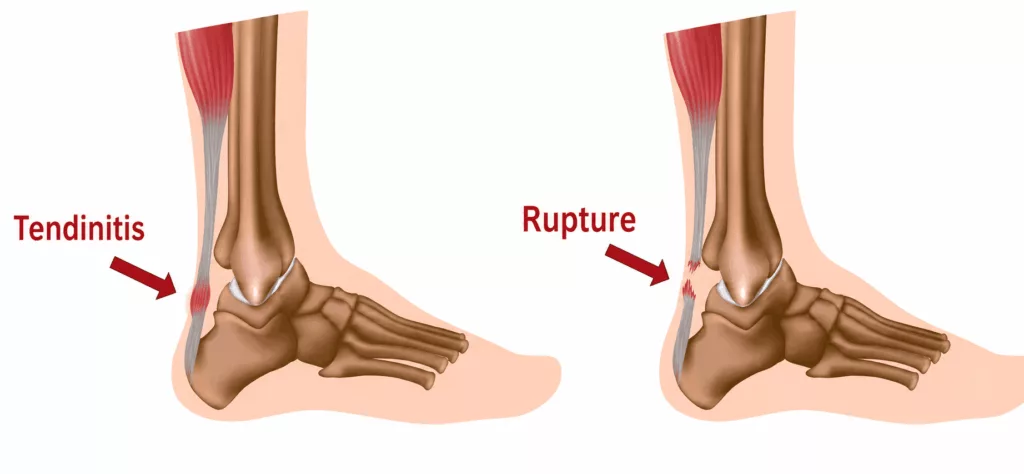
The Achilles tendon connects the calf muscles to the heel bone (calcaneus). It enables ankle plantarflexion and provides the propulsion required for walking, running and jumping.
Achilles tendinopathy is a disorder caused by the accumulation of repeated microscopic injuries within the tendon. It may develop either at the tendon’s insertion into the calcaneus (insertional tendinopathy) or within the main body of the tendon (mid-portion tendinopathy).
Repeated overuse of the ankle can lead to tiny tears within the tendon fibres. As these injuries accumulate, the body attempts to repair them, resulting in local inflammation, structural degeneration and, in some cases, calcium deposits within the tendon. When this process persists over time, it develops into chronic Achilles tendinopathy.
Without appropriate management, the condition may cause significant pain and, in advanced cases, increase the risk of Achilles tendon rupture.
Causes and Risk Factors for Achilles Tendinopathy
Ankle Surgery Specialist in Hauts-de-Seine (92)
Achilles tendinopathy may be degenerative, resulting from the natural ageing process that reduces the tendon’s elasticity and mechanical strength, or overuse-related, caused by repetitive or excessive physical loading.
The condition is particularly common among athletes involved in sports requiring repetitive running, sprinting and jumping.
Several factors increase the risk of developing Achilles tendinopathy, including:
- a sudden increase in training intensity or volume;
- training on hard surfaces;
- inappropriate or worn footwear;
- inadequate hydration;
- tobacco and excessive alcohol consumption.
Achilles Tendinopathy in Rueil-Malmaison
Ankle Surgery in Hauts-de-Seine
Preventing Achilles Tendinopathy
Maintaining good ankle flexibility and calf muscle strength helps reduce the risk of Achilles tendon disorders.
Appropriate warm-up exercises before sport, together with regular stretching and strengthening programmes, are strongly recommended.
Training intensity should always be increased progressively to avoid overloading the tendon.
A healthy lifestyle also plays an important role in tendon health. Adequate hydration and limiting tobacco and alcohol consumption contribute to reducing the risk of tendinopathy.
Symptoms of Achilles Tendinopathy
Pain is the principal symptom of Achilles tendinopathy. It is typically localised either at the insertion of the tendon into the heel or within the tendon itself.
The tendon may become swollen and warm to the touch.
Initially, pain occurs only during sporting activities. As the condition progresses, symptoms become increasingly frequent and may eventually persist during everyday activities and even at rest.
This pain progressively limits sporting performance and may interfere with normal daily function. In advanced cases, untreated tendinopathy may ultimately result in tendon rupture.
Diagnosis of Achilles Tendinopathy
The consultation begins by identifying the circumstances in which symptoms developed and evaluating their impact on sporting activities and daily life.
Clinical examination focuses on identifying localised tenderness along the Achilles tendon. Functional tests, including heel raises and hopping manoeuvres, are performed to reproduce symptoms. The mobility and stability of the ankle are also assessed to exclude associated conditions.
Weight-bearing ankle radiographs may be requested to identify calcification or ossification within the tendon.
Magnetic resonance imaging (MRI) remains the reference examination, providing detailed assessment of the tendon lesion, its extent and any associated abnormalities.
Treatment of Achilles Tendinopathy
Initial treatment is conservative.
This usually combines approximately 30 days of activity modification, the use of a heel lift to reduce tension within the tendon, and anti-inflammatory medication where appropriate.
Contributing factors should also be addressed by:
- adapting footwear;
- maintaining adequate hydration;
- reducing tobacco and alcohol consumption;
- introducing a structured programme of stretching and strengthening exercises during recovery and return to sport.
Corticosteroid injections are generally avoided, as they may weaken the tendon and increase the risk of rupture.
If symptoms persist despite appropriate conservative treatment, surgical management may be considered.