
Ankle Arthrodesis in Hauts-de-Seine
Ankle Surgery
What is ankle arthrodesis?
Dr Simon Tournemine in Hauts-de-Seine (92)
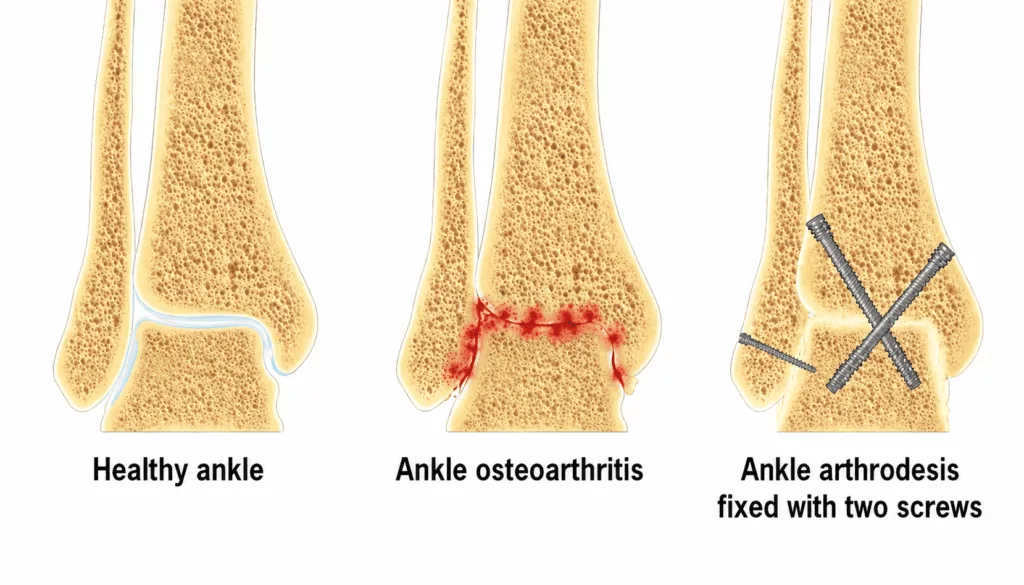
Ankle osteoarthritis (tibiotalar osteoarthritis) is the progressive wear of the joint between the lower leg bone (the tibia) and the talus. This degeneration causes pain and a gradual loss of ankle mobility. No treatment can reverse this wear, and without appropriate management the condition progressively worsens. Various conservative treatments may help relieve symptoms, but when joint degeneration becomes advanced and these measures are no longer effective, surgery may be recommended.
Ankle arthrodesis is a surgical procedure that involves removing the worn joint surfaces before permanently fusing the tibia and talus in the correct anatomical position. This eliminates painful movement within the joint, allowing patients to walk comfortably and return to their daily activities without pain.
Ankle Arthrodesis Procedure
Specialist in Ankle Surgery in Hauts-de-Seine (92)
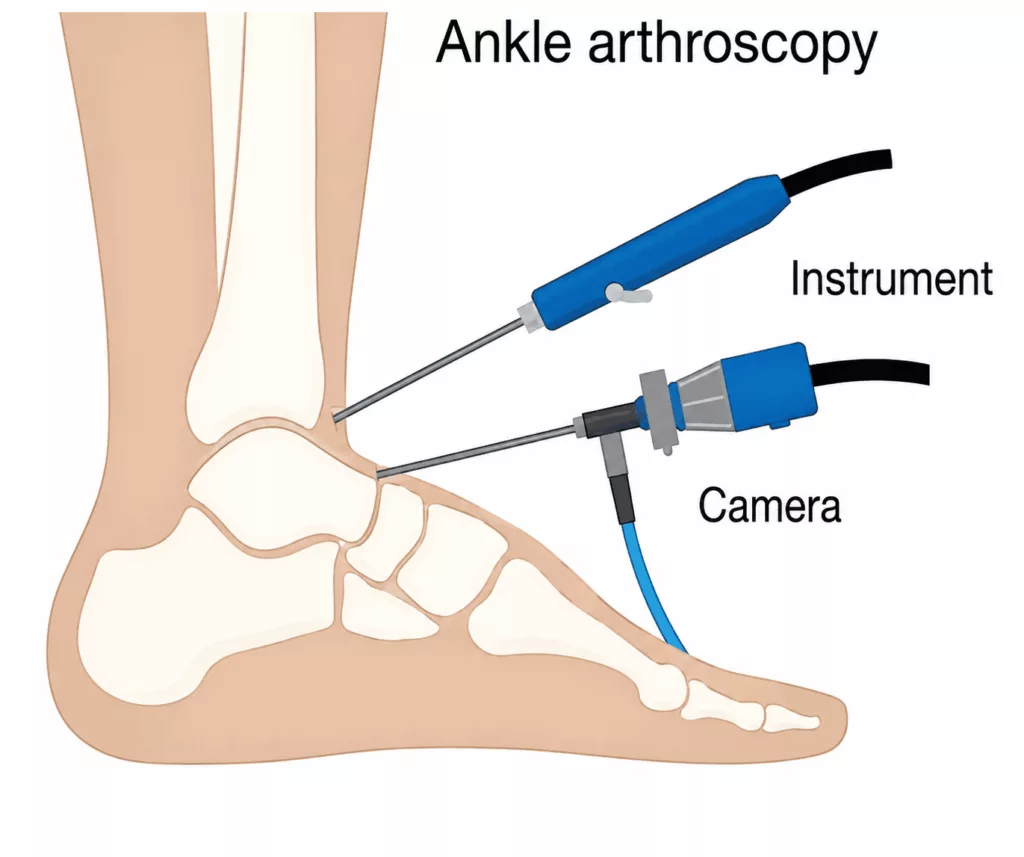
Whenever possible, this procedure is performed arthroscopically. However, in certain cases an open procedure may be required. Arthroscopic surgery is a minimally invasive, video-assisted technique that avoids opening the joint. Two small incisions of approximately 10 mm are made at the front of the ankle to introduce a miniature camera together with the specialised surgical instruments required for the procedure.
The damaged cartilage is removed, and the underlying bone surfaces are carefully prepared to stimulate bone healing. The ankle is then positioned in the correct alignment and stabilised using two screws. These screws are not normally troublesome and do not require routine removal.
The operation takes approximately 60 minutes.
It is performed under either general anaesthesia or spinal anaesthesia (where only the legs are anaesthetised). The most suitable anaesthetic technique will be discussed with your anaesthetist during your preoperative consultation.
Ankle Arthrodesis in Rueil-Malmaison
Ankle Surgery in Hauts-de-Seine
Ankle Fusion Surgery
When is ankle arthrodesis recommended?
Ankle osteoarthritis is a degenerative condition that cannot be cured, and its natural progression is towards increasing joint deterioration. Various treatments are used to relieve pain and slow disease progression, including lifestyle modifications, pain-relieving medication, anti-inflammatory drugs, physiotherapy and corticosteroid injections.
When these conservative treatments no longer provide sufficient symptom relief because the joint damage has become too advanced, surgical treatment may be recommended.
Postoperative care and rehabilitation following ankle arthrodesis
Pain management is carefully monitored after surgery to maximise comfort and promote early recovery. Anticoagulant medication is prescribed to reduce the risk of deep vein thrombosis.
The ankle must remain immobilised for six weeks to allow the bones to fuse successfully. During this period, walking is permitted using two crutches without weight-bearing on the operated ankle.
After six weeks, the cast is removed and weight-bearing is gradually resumed while wearing a removable walking boot.
Driving is generally possible after approximately three months, and sporting activities can usually be resumed after around four months. These recovery periods are average estimates and vary according to each patient’s individual progress.
Following removal of the immobilisation at six weeks, physiotherapy is required to restore leg muscle strength and maintain the flexibility of the foot.
The procedure is usually performed as day-case surgery, allowing patients to return home on the day of the operation. In some cases, however, admission to a rehabilitation centre may be recommended before returning home to regain full independence.
Long-term clinical and radiographic follow-up remains essential to monitor the ankle and detect any potential abnormalities.
Risks and complications of ankle arthrodesis
Every precaution is taken to ensure the safest possible outcome. Nevertheless, as with any surgical procedure, complications, although uncommon, may occur.
Potential complications include:
- Deep vein thrombosis (DVT) and pulmonary embolism: uncommon complications minimised through anticoagulant treatment during the postoperative period.
- Exacerbation of pre-existing medical conditions: such as heart failure or diabetes. Careful postoperative monitoring is provided by the anaesthetic team.
- Infection (risk below 1%): this may require further surgery to clean the operative site, followed by antibiotic treatment.
- Haematoma: postoperative bleeding may occasionally result in a haematoma requiring drainage or, more rarely, blood transfusion.
- Injury to small superficial sensory nerve branches: this uncommon complication may lead to reduced sensation in certain areas around the ankle.
- Non-union (pseudoarthrosis): failure of the bones to fuse is an uncommon complication that may require a longer period of immobilisation or, in some cases, additional surgery to stimulate bone healing.
- Prominent or symptomatic hardware: the implanted screws may occasionally cause discomfort or irritation of the surrounding anatomical structures, requiring removal during a later procedure.
Complex Regional Pain Syndrome (CRPS) is a rare and poorly understood painful inflammatory condition. It is managed medically and may persist for several months, or occasionally years, requiring specialised rehabilitation, additional investigations and, in some cases, dedicated pain management. Its onset, progression and long-term consequences remain unpredictable.
Walking comfort depends partly on the final position of the fused ankle. In certain cases, custom orthotic insoles, specialised footwear or, more rarely, revision surgery to adjust the position of the arthrodesis may be required.
These represent the principal recognised risks but do not constitute an exhaustive list. Other rare or exceptional complications may occur. Not every possible complication can be listed, and your surgeon will be pleased to discuss any specific concerns relating to your individual case.
Results of ankle arthrodesis
Excellent outcomes are achieved in the majority of patients thanks to modern minimally invasive arthroscopic techniques.
Most patients are able to resume walking and return to their usual daily activities without pain from approximately three months after surgery.
Although the ankle joint itself is permanently fused, this generally does not significantly impair walking, as the numerous surrounding joints within the foot compensate for the loss of ankle motion.
Sports such as skiing, cycling and tennis remain possible and may even be encouraged. However, activities requiring repetitive running are generally compromised.
Ankle arthrodesis remains the treatment of choice for many young and active patients who place significant long-term demands on their ankle joint.