
Peroneal Tendon Repair & Stabilisation in Hauts-de-Seine
Ankle Surgery
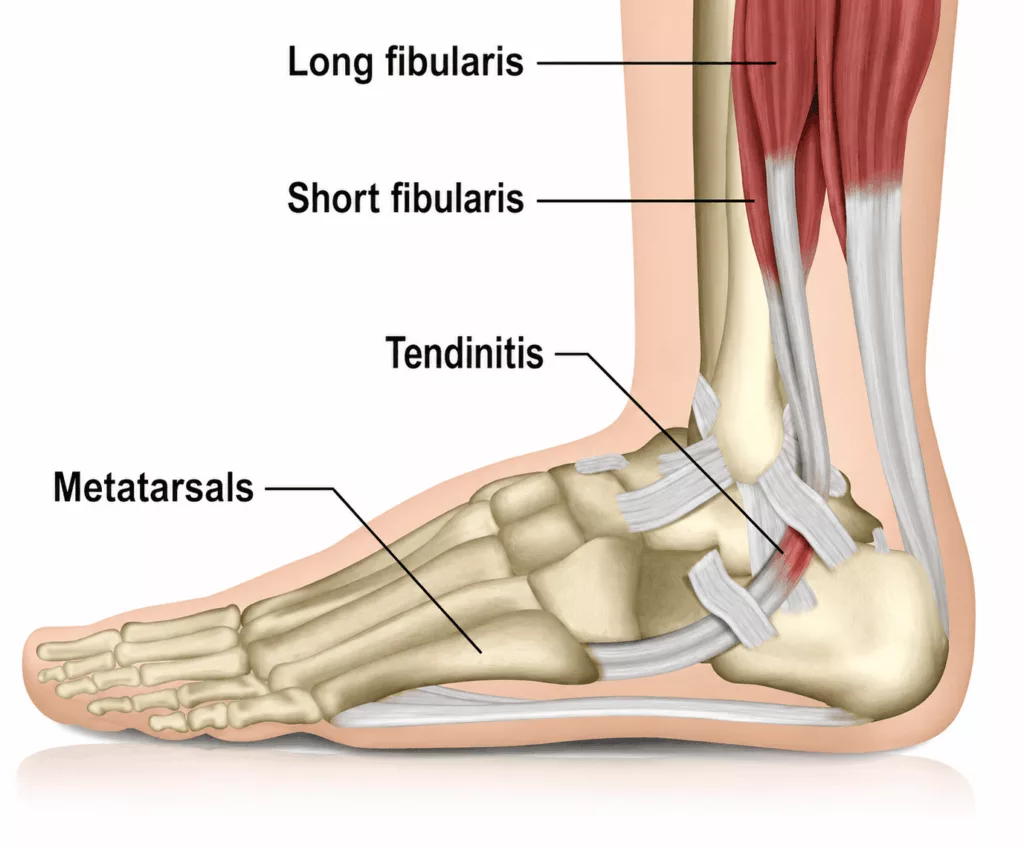
What is peroneal tendon repair and stabilisation?
Dr Simon Tournemine in Hauts-de-Seine (92)
Two tendons run along the outer aspect of the ankle: the peroneus brevis and peroneus longus tendons. They originate in the lower leg, pass through a groove behind the lateral malleolus, and insert distally into the metatarsal bones. Their primary role is to stabilise the ankle while enabling plantarflexion and eversion of the foot.
Two main disorders can affect the peroneal tendons:
- Peroneal tendinopathy (tendinitis): the tendons become painful and weakened, potentially progressing to partial or complete rupture.
- Peroneal tendon instability (dislocation): the tendons slip out of their normal groove behind the lateral malleolus.
When should peroneal tendon repair and stabilisation be performed?
Specialist in Ankle Surgery in Hauts-de-Seine (92)
For peroneal tendinopathy, treatment initially consists of conservative measures including rest, anti-inflammatory medication and the use of corrective orthotic insoles where appropriate. Corticosteroid injections are contraindicated because they may weaken the tendons and increase the risk of rupture. If symptoms persist despite appropriate non-operative treatment, surgery may be recommended.
When a peroneal tendon rupture occurs, surgical repair is generally required, as these tendons are unable to heal adequately on their own.
In cases of peroneal tendon dislocation, surgical stabilisation is the treatment of choice. Immobilisation alone does not provide reliable long-term tendon stability.
Peroneal Tendon Repair & Stabilisation in Rueil-Malmaison
Ankle Surgery in Hauts-de-Seine
Peroneal tendon repair and stabilisation procedure
For persistent peroneal tendinopathy that has failed conservative treatment, the tendon sheath is opened longitudinally and each tendon is carefully examined. Inflamed tissue is excised, while weakened or damaged tendon fibres are repaired with sutures to promote optimal healing.
Where a tendon rupture is present, direct tendon repair is performed whenever possible. If the tendon damage is too extensive to allow primary repair, a tenodesis is carried out, whereby the damaged tendon is sutured to the healthy tendon to restore strength and function.
Surgery for peroneal tendon disorders is frequently combined with the treatment of associated conditions, including ankle instability, prominent osteophytes or hindfoot varus deformity.
In cases of peroneal tendon instability, surgery aims to reposition the tendons within their normal anatomical groove while repairing and reinforcing the tendon sheath and the superior peroneal retinaculum, which provides additional stability. Any associated abnormality of the retromalleolar groove may also be corrected during the same procedure.
These procedures generally take approximately 30 minutes.
They are performed under either general anaesthesia or spinal anaesthesia (where only the legs are anaesthetised). The choice of anaesthesia will be discussed with your anaesthetist during your preoperative consultation.
The procedure is performed as day-case surgery, allowing you to return home on the same day.
Postoperative care and rehabilitation following peroneal tendon repair and stabilisation
The dressing should be changed every two days for approximately two weeks. A comprehensive pain management programme is implemented and closely monitored to maximise comfort and facilitate early rehabilitation. Anticoagulant treatment is prescribed throughout the period of immobilisation to reduce the risk of deep vein thrombosis.
The operation is performed as day-case surgery, and you will return home on the evening of the procedure.
The ankle is immobilised in a removable walking boot for approximately six weeks. Depending on the condition of the tendons and the extent of the repair, weight-bearing may be resumed between two and six weeks after surgery.
Physiotherapy should begin promptly to preserve muscle strength and maintain ankle flexibility throughout recovery.
Return to work is generally possible after approximately three weeks, although this depends on the nature of your occupation. Office-based work may often be resumed earlier. Sporting activities can usually be restarted after around eight weeks.
These recovery times are average estimates and may vary according to each patient’s individual progress.
Long-term clinical and radiographic follow-up remains essential to monitor healing and detect any potential complications.
Risks and complications following peroneal tendon repair and stabilisation
Every precaution is taken to ensure the safest possible outcome. Nevertheless, as with any surgical procedure, complications, although uncommon, may occur.
Potential complications include:
- Deep vein thrombosis (DVT) and pulmonary embolism: uncommon complications minimised through anticoagulant treatment during the postoperative period.
- Exacerbation of pre-existing medical conditions: such as heart failure or diabetes. Careful postoperative monitoring is provided by the anaesthetic team.
- Infection (risk below 1%): this may require further surgery to clean the operative site, followed by antibiotic treatment.
- Reduced ankle mobility and postoperative stiffness: these may occur if rehabilitation is not carried out appropriately.
- Haematoma: postoperative bleeding may occasionally result in a haematoma requiring drainage or, more rarely, blood transfusion.
- Injury to small superficial sensory nerve branches: this uncommon complication may lead to reduced sensation in certain areas around the ankle.
- Complex Regional Pain Syndrome (CRPS): a rare and poorly understood painful inflammatory condition that may persist for several months, or occasionally years. It requires specialised rehabilitation, additional investigations and, in some cases, dedicated pain management. Its onset, progression and long-term consequences remain unpredictable.
These represent the principal recognised risks but do not constitute an exhaustive list. Other rare or exceptional complications may occur. Not every possible complication can be listed, and your surgeon will be pleased to discuss any specific concerns relating to your individual case.
Results of peroneal tendon repair and stabilisation
For peroneal tendinopathy, surgery relieves pain and restores tendon integrity, allowing a pain-free return to sport and everyday activities. It also helps preserve tendon quality and reduces the long-term risk of tendon rupture.
When treating peroneal tendon tears, surgical repair restores tendon continuity, relieves pain and improves ankle stability. A stable ankle is essential for preventing recurrent sprains and reducing the long-term risk of degenerative ankle osteoarthritis.
For peroneal tendon dislocation, surgery restores the tendons to their anatomical groove and stabilises them permanently. This also protects the tendons over time, as recurrent dislocations progressively weaken the tendons and may ultimately lead to rupture.