
Claw toe is a common foot deformity that affects one or more toes (often the second, third, or fourth). While this condition usually starts painlessly or as a simple nuisance in shoes, it can progress and become severely debilitating. Facing chronic pain or difficulty wearing shoes, the question of surgical treatment arises. When should you undergo surgery for a claw toe? Detailed explanations of surgical indications, warning signs, and management options.
What is a claw toe (or hammer toe)?
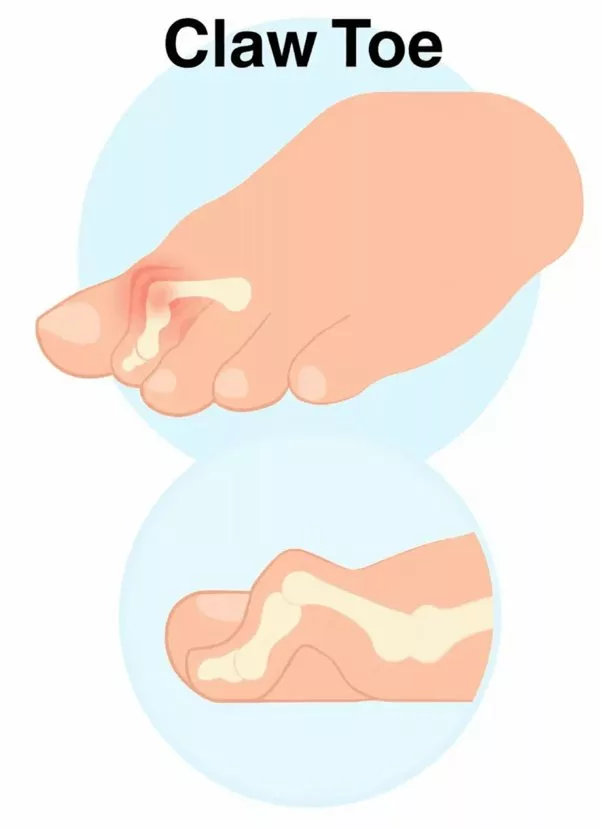
Claw toe corresponds to a progressive retraction of the tendons and ligaments that control the toe joints. This leads to hyperflexion of the phalanges: the toe curls up and points downward, while the interphalangeal joint bulges upward.
Two stages should be distinguished:
- Flexible (or reducible) claw toe: The deformity can still be manually corrected during a clinical examination.
- Fixed (or rigid) claw toe: The joint is locked in a abnormal position. It is impossible to straighten the toe by hand.
Medical treatments before surgery
Initially, management of a claw toe is always medical and conservative. Surgery is never offered right away, except in cases of severe skin or infectious complications.
Before considering an operation, several medical solutions should be tried:
- Footwear adjustment: Wearing wider shoes, without aggressive seams over the forefoot, and without heels.
- Podiatry care: To trim painful corns or calluses formed by repetitive friction.
- Orthoplasties: Making small, custom silicone orthoses to protect friction zones.
- Orthotic insoles (plantar orthoses): To modify pressure distribution under the forefoot and reduce hyperpressure.
While these treatments help relieve pain and slow the progression of claw toe, they cannot correct the deformity or permanently cure it.
When does surgery become necessary?
Claw toe surgery is considered when conservative treatments are no longer sufficient to ensure comfort. Three main criteria set the surgical indication:
- Persistent pain and shoe-fitting discomfort
The main reason for surgery is pain. It usually manifests on top of the toe due to rubbing against the shoe, or under the foot (metatarsalgia) from excessive pressure on the metatarsal heads. When simply putting on shoes or walking becomes uncomfortable despite wearing adapted footwear, surgery should be discussed.
- Fixed and irreducible deformity
When the claw toe becomes fixed (rigid), the tendons have permanently retracted. Silicone orthoses or insoles can no longer correct the position of the toe. Surgery then makes it possible to restore a flat anatomical alignment to give the foot a normal shape.
- Skin complications (corns, calluses, wounds)
Chronic friction leads to the appearance of painful corns on the top of the toe or at its tip. In certain patients, particularly diabetic individuals or those suffering from vascular disorders, these hyperpressures can progress to ulcerations or infected wounds. To avoid any risk of bone infection (osteomyelitis), surgical correction is urgently required.
What does claw toe surgery involve?
The goal of surgery is to realign the toe and remove the bump responsible for friction. Depending on the severity of the deformity and the rigidity of the claw toe, the orthopedic surgeon adjusts their technique:
- On a flexible claw toe: The procedure mainly targets soft tissues (release or lengthening of retracted tendons).
- On a fixed claw toe: A partial bone resection of the locked joint (arthroplasty) is required in addition to tendon lengthening.
These procedures are performed as outpatient surgery under regional anesthesia. Nowadays, minimally invasive or percutaneous techniques allow these procedures to be performed through tiny incisions, thereby reducing scarring and post-operative pain. Resuming full weight-bearing walking is possible on the day of surgery.
Key takeaways
Claw toe surgery should not be performed for purely cosmetic reasons. The decision to operate relies on the failure of medical treatments, functional discomfort, and the appearance of skin or infectious complications. If you notice toe deformities or experience difficulties wearing shoes, consult an orthopedic surgeon for a precise evaluation.