
Knee osteoarthritis (gonarthrosis) is a common condition that progressively wears down the joint’s cartilage, leading to pain and stiffness. But did you know that when this wear only affects one part of the knee, it is not always necessary to replace the entire joint?
The partial knee replacement, medically known as Unicompartmental Knee Arthroplasty (UKA), is a custom, less invasive surgical solution that allows for a much faster recovery than a total knee replacement.
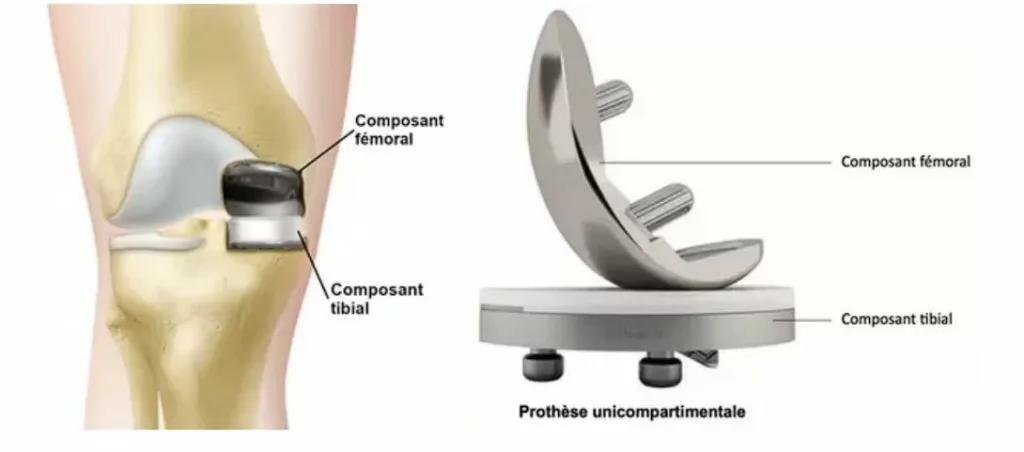
What is a unicompartmental knee arthroplasty (UKA)?
The knee is divided into three compartments (medial, lateral, and patellofemoral). In about 30% of osteoarthritis cases, cartilage wear is isolated to a single compartment, most commonly the medial (inner) compartment.
Instead of replacing the entire joint with a Total Knee Arthroplasty (TKA), UKA surgery involves resurfacing only the damaged area. The surgeon thereby preserves healthy bone, the intact cartilage of the other compartments, and most importantly, all your cruciate ligaments. This is known as “à la carte” or joint preservation surgery.
The 3 major benefits of a partial knee replacement
If your osteoarthritis permits, choosing a partial replacement offers major benefits compared to a total replacement:
- A “natural knee” feeling: Since your cruciate ligaments (anterior and posterior) are preserved, the biomechanics (the way your knee moves) are not altered. Patients report a knee that feels much more natural than with a total replacement.
- A minimally invasive and less painful surgery: The incision is smaller, bleeding is reduced, and bone alteration is minimal. Post-operative recovery is therefore significantly less painful.
- (Very) rapid recovery: Thanks to Enhanced Recovery After Surgery (ERAS) protocols, patients can stand and walk on the day of the procedure. Returning to work and sports activities (cycling, swimming, etc.) is much earlier.
Are you a good candidate for this surgery?
Partial knee replacement isn’t for everyone. To benefit from this technique, several strict criteria must be met during your exams (X-rays, MRI) and orthopedic consultation:
- Osteoarthritis must be strictly limited to a single compartment (usually medial tibiofemoral).
- Your anterior cruciate ligament (ACL) must be intact and functional.
- There must be no significant deformity in the alignment of your leg.
- The joint must not have major stiffness before the operation.
If your knee is globally worn, a Total Knee Replacement remains the standard indication. Procedure and recovery
The surgery
The operation lasts about 45 minutes to 1 hour. It can be performed under general or regional anesthesia (spinal anesthesia). As a lower limb specialist, I use minimally invasive approaches that spare muscles and tendons, ensuring a quick return to autonomy.
Rehabilitation and returning home
Rehabilitation begins immediately. You will take your first steps in the hours following the surgery with the help of physical therapists.
- Discharge: The procedure can often be done as outpatient surgery (returning home the same evening) or with a short hospital stay of one to two nights maximum.
- Walking: You will walk with crutches for 1 to 3 weeks, mainly to relieve the joint while it heals.
- Return to sports: Non-impact sports (stationary bike, swimming) can be resumed quickly, generally between the 3rd and 6th week.
Book an appointment for an evaluation of your osteoarthritis
Every knee is unique. Only a precise clinical and radiological evaluation can determine if you are eligible for a partial knee replacement.
As an orthopedic surgeon specializing in lower limb conditions, I welcome you in consultation to analyze your cartilage wear and offer the most suitable surgical solution.