
Ankle Fracture Internal Fixation in Hauts-de-Seine
Ankle Surgery
What is ankle fracture internal fixation?
Dr Simon Tournemine in Hauts-de-Seine (92)
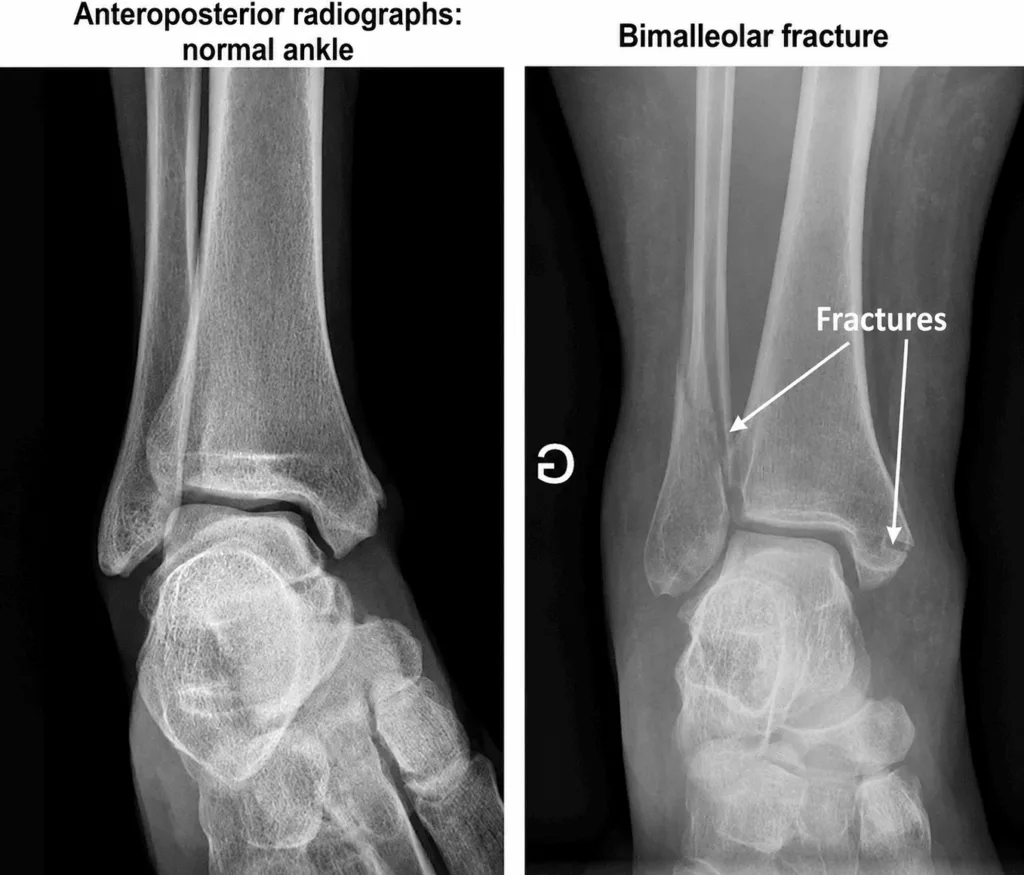
Like any fracture, an ankle fracture involves a break in the continuity of a bone. The medial malleolus of the tibia and the lateral malleolus of the fibula form the junction between the leg and the foot and play a crucial role in stabilising the ankle joint. This vulnerable area is commonly affected by fractures.
An isolated lateral malleolus fracture occurs when only the fibula is broken, whereas a bimalleolar fracture involves both the tibia and the fibula.
Without surgical treatment, the natural progression of these fractures is generally unfavourable. The ankle may remain painful, deformed and stiff, making normal walking difficult or impossible.
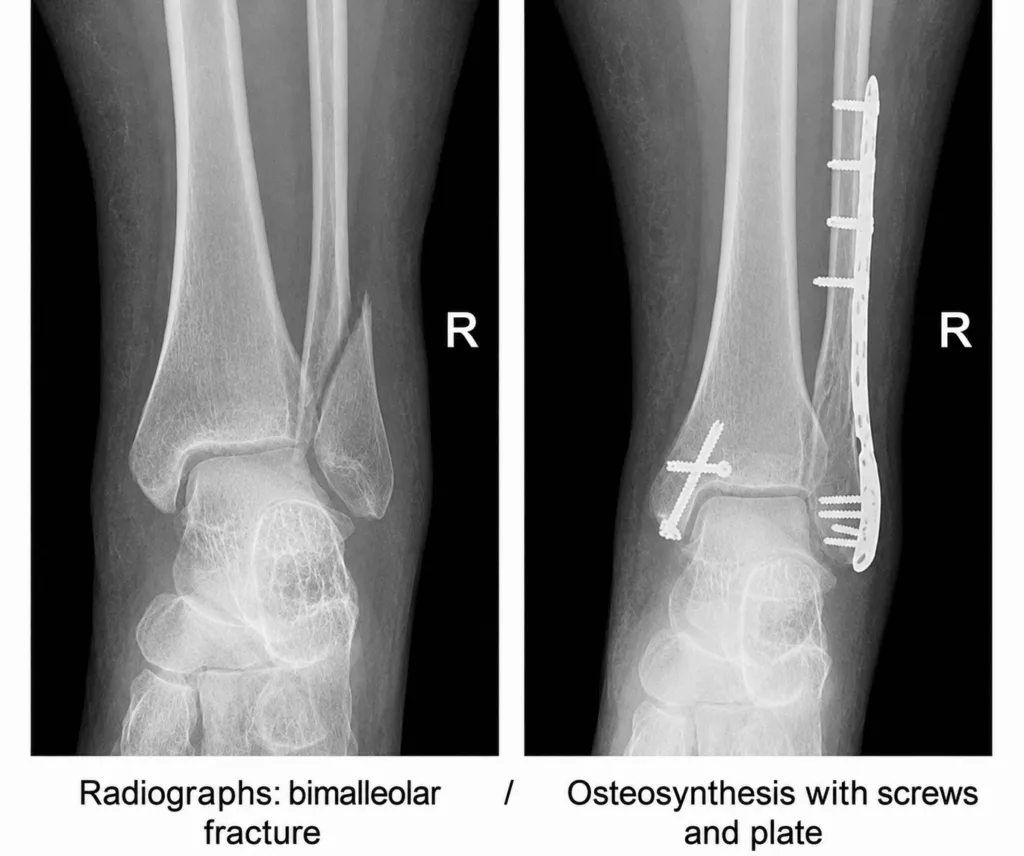
When the fracture is displaced or unstable, the broken bone fragments must be accurately repositioned and stabilised using metal implants to allow healing in the correct anatomical position. This procedure is known as internal fixation (osteosynthesis).
Ankle Fracture Internal Fixation Surgery
Specialist in Ankle Surgery in Hauts-de-Seine (92)
This is a common orthopaedic procedure. Surgery generally takes around 30 minutes when only one bone is fractured and approximately one hour when both bones require fixation.
The operation is performed under either general anaesthesia or spinal anaesthesia (where only the legs are anaesthetised). The most appropriate anaesthetic technique will be discussed with your anaesthetist during your preoperative consultation.
An incision of approximately 15 cm is made along the outer aspect of the ankle. If the tibia is also fractured, a second incision of approximately 5 cm may be required on the inner side of the ankle.
These approaches allow direct access to the fracture so that the bone fragments can be restored to their normal anatomical position. Metal implants, typically plates and screws, are then used to stabilise the fracture while the bone heals.
In most cases, this procedure is performed as day-case surgery, allowing you to return home on the same day.
Ankle Fracture Internal Fixation in Rueil-Malmaison
Ankle Surgery in Hauts-de-Seine
When should ankle fracture internal fixation be performed?
Surgery should ideally be carried out as soon as possible after the fracture.
After approximately 15 days, the fracture begins to heal in its displaced position, making surgery considerably more complex because the bone may need to be rebroken before it can be restored to its correct alignment.
Postoperative care and rehabilitation following ankle fracture internal fixation
Pain management is carefully monitored to maximise comfort and promote early rehabilitation. Anticoagulant treatment is prescribed throughout the period of immobilisation to reduce the risk of deep vein thrombosis.
The ankle is immobilised in a cast for approximately six weeks. Walking is permitted using two crutches, allowing the operated ankle to remain protected while the fracture heals.
The cast is removed after six weeks. Physiotherapy then becomes essential to restore muscle strength and recover ankle mobility and flexibility.
Return to work may be possible from approximately three weeks, depending on your occupation. Office-based work can often be resumed sooner.
Driving is generally possible after around eight weeks, while sporting activities may usually be resumed after approximately three months.
These recovery times are average estimates and vary according to each patient’s individual healing process.
Long-term clinical and radiographic follow-up remains essential to monitor bone healing and identify any potential complications.
Risks and complications of ankle fracture internal fixation
Every precaution is taken to ensure the safest possible outcome. Nevertheless, as with any surgical procedure, complications, although uncommon, may occur.
Potential complications include:
- Deep vein thrombosis (DVT) and pulmonary embolism: uncommon complications minimised through anticoagulant treatment during the period of immobilisation.
- Exacerbation of pre-existing medical conditions: such as heart failure or diabetes. Careful postoperative monitoring is provided by the anaesthetic team.
- Infection (risk below 1%): this may require further surgery to clean the operative site, followed by antibiotic treatment.
- Reduced ankle mobility and postoperative stiffness: these may occur if rehabilitation is not carried out appropriately.
- Haematoma: postoperative bleeding may occasionally result in a haematoma requiring drainage or, more rarely, blood transfusion.
- Injury to small superficial sensory nerve branches: this uncommon complication may lead to reduced sensation in certain areas around the ankle.
- Non-union (pseudarthrosis): in some cases, the fracture fails to heal. Immobilisation may need to be prolonged, and additional surgery may be required to stimulate bone healing.
- Complex Regional Pain Syndrome (CRPS): a rare and poorly understood painful inflammatory condition that may persist for several months, or occasionally years. It requires specialised rehabilitation, additional investigations and, in some cases, dedicated pain management. Its onset, progression and long-term consequences remain unpredictable.
- Post-traumatic ankle osteoarthritis: degeneration of the ankle joint may develop over time following any fracture involving the joint surface.
These represent the principal recognised risks but do not constitute an exhaustive list. Other rare or exceptional complications may occur. Not every possible complication can be listed, and your surgeon will be pleased to discuss any specific concerns relating to your individual case.
Results of ankle fracture internal fixation
Without surgery, the natural progression of displaced ankle fractures is generally poor. Persistent pain, deformity and loss of mobility can significantly impair walking and daily activities.
Internal fixation restores the fractured bones to their correct anatomical position and stabilises them with metal implants, allowing optimal bone healing.
Complete recovery is generally achieved approximately three months after surgery.
In the great majority of patients, the procedure restores a stable, pain-free and mobile ankle, allowing a return to normal daily activities, including sporting activities.