
Anterior Ankle Impingement Resection in Hauts-de-Seine
Ankle Surgery
What is anterior ankle impingement resection?
Dr Simon Tournemine in Hauts-de-Seine (92)
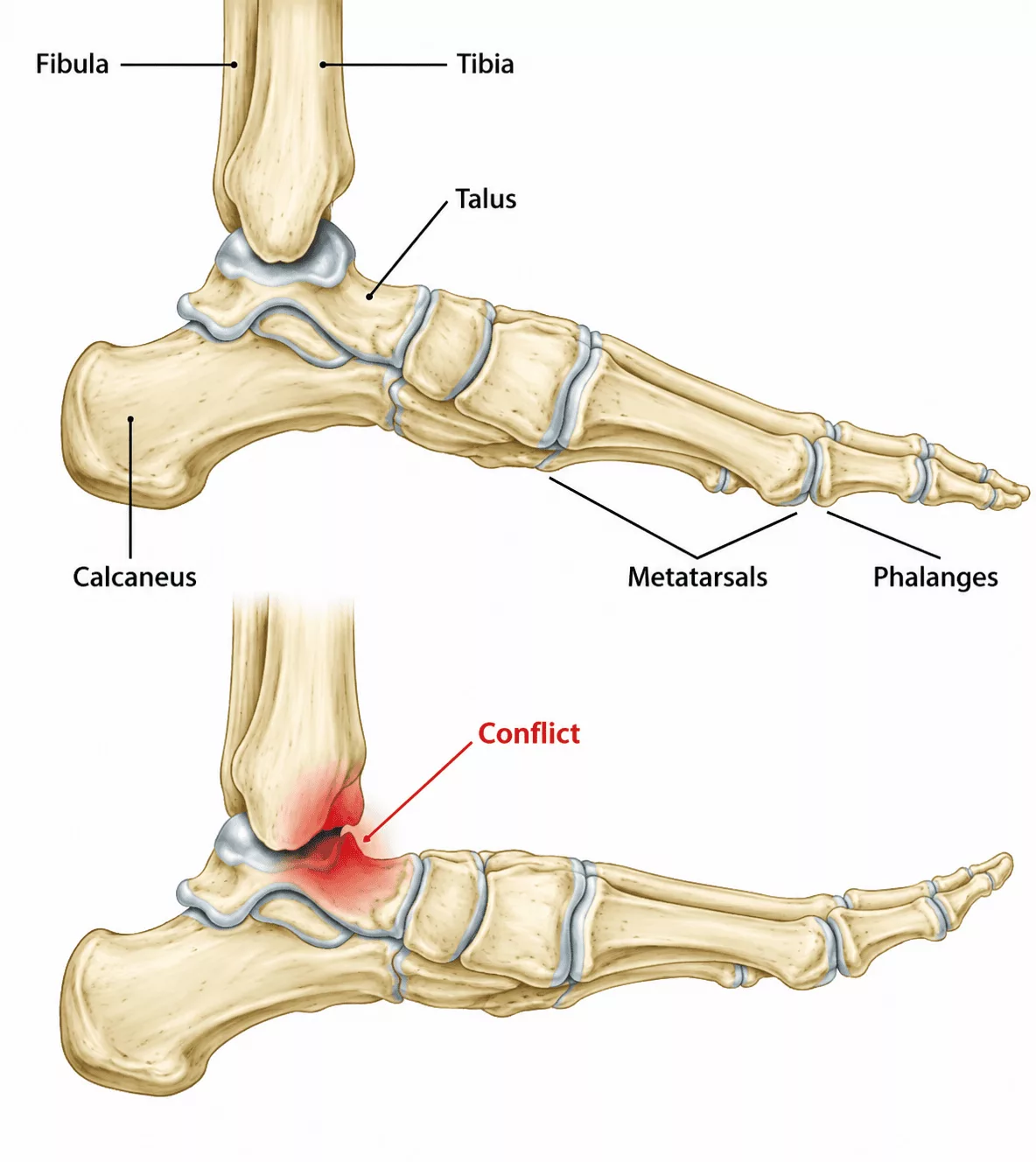
The ankle joint is the articulation between the lower leg bone (the tibia) and the foot bone (the talus). It allows movements of dorsiflexion and plantarflexion. An ankle impingement occurs when tissue becomes trapped within the joint during movement, restricting motion and causing pain. The impingement may be caused by bony overgrowths (osteophytes) or soft tissues such as ligaments or the synovial membrane.
Anterior ankle impingement most commonly develops following repeated ankle sprains or recurrent trauma. These injuries damage the bones and ligaments of the ankle. As healing occurs, excessive scar tissue and bony overgrowth may develop, creating abnormal tissue that becomes trapped within the joint during movement.
Anterior ankle impingement typically presents with pain at the front of the ankle during activity. This pain is frequently associated with a feeling of ankle instability resulting from previous ligament injuries. If left untreated for several years, the condition may progressively damage the joint and contribute to the development of ankle osteoarthritis.
Anterior Ankle Impingement Resection Procedure
Specialist in Ankle Surgery in Hauts-de-Seine (92)
The aim of surgery is to remove the bony prominences and soft tissues responsible for the impingement.
This procedure is performed arthroscopically using a minimally invasive, video-assisted technique that avoids opening the joint. Two small incisions of approximately 5 mm are made at the front of the ankle to introduce a miniature camera together with the specialised instruments required to remove the impinging tissue.
Compared with traditional open surgery, this minimally invasive approach offers several advantages, including smaller scars, reduced postoperative pain and a faster recovery.
The operation takes approximately 30 minutes.
It is performed under either general anaesthesia or spinal anaesthesia (where only the legs are anaesthetised). The most appropriate anaesthetic technique will be discussed with your anaesthetist during your preoperative consultation.
The procedure is performed as day-case surgery, allowing you to return home on the same day.
Anterior Ankle Impingement Resection in Rueil-Malmaison
Ankle Surgery in Hauts-de-Seine
When is anterior ankle impingement resection recommended?
Anterior ankle impingement is initially managed with conservative treatment. This usually combines temporary rest, anti-inflammatory medication and, in some cases, a corticosteroid injection into the impingement site.
If conservative treatment fails to relieve symptoms and pain continues to limit daily activities or sporting participation, surgical treatment may be recommended.
Postoperative rehabilitation following anterior ankle impingement resection
Dressings should be changed every two days for approximately two weeks. Pain management is carefully monitored to maximise comfort and facilitate early rehabilitation. Anticoagulant treatment is prescribed for two weeks to reduce the risk of deep vein thrombosis.
The ankle is protected in a removable Aircast-type brace for three weeks.
Full weight-bearing walking is permitted immediately after surgery, according to pain tolerance, and patients are encouraged to resume normal daily activities as symptoms allow. Physiotherapy is recommended to maintain muscle strength and restore ankle flexibility.
Time away from work is generally around three weeks, while sporting activities can usually be resumed after approximately six weeks. These recovery periods are average estimates and vary according to each patient’s individual progress.
Long-term clinical and radiographic follow-up remains important to monitor the ankle and detect any potential abnormalities.
Risks and complications of anterior ankle impingement resection
Every precaution is taken to ensure the safest possible outcome. Nevertheless, as with any surgical procedure, complications, although uncommon, may occur.
Potential complications include:
- Deep vein thrombosis (DVT) and pulmonary embolism: uncommon complications minimised through anticoagulant treatment during the postoperative period.
- Exacerbation of pre-existing medical conditions: such as heart failure or diabetes. Careful postoperative monitoring is provided by the anaesthetic team.
- Infection (risk below 1%): this may require further surgery to clean the operative site, followed by antibiotic treatment.
- Reduced ankle mobility and postoperative stiffness: these may occur if rehabilitation is not carried out appropriately.
- Haematoma: postoperative bleeding may occasionally result in a haematoma requiring drainage or, more rarely, blood transfusion.
- Injury to small superficial sensory nerve branches: this uncommon complication may lead to reduced sensation in certain areas around the ankle.
- Complex Regional Pain Syndrome (CRPS): a rare and poorly understood painful inflammatory condition that may persist for several months, or occasionally years, requiring specialised rehabilitation, additional investigations and, in some cases, dedicated pain management. Its onset, progression and long-term consequences remain unpredictable.
These represent the principal recognised risks but do not constitute an exhaustive list. Other rare or exceptional complications may occur. Not every possible complication can be listed, and your surgeon will be pleased to discuss any specific concerns relating to your individual case.
Results of anterior ankle impingement resection
Without treatment, anterior ankle impingement generally follows a progressive course, with persistent or worsening pain. Over time, the lesions may extend and gradually damage the entire ankle joint, ultimately leading to osteoarthritis.
The objectives of surgery are twofold:
- to relieve pain and enable a return to sporting activities;
- to preserve the ankle joint and reduce the risk of long-term degenerative changes, including osteoarthritis.
Approximately 80% of patients experience significant pain relief and are able to return to sporting activities following surgery.