
Quintus Varus in Hauts-de-Seine
Foot Surgery
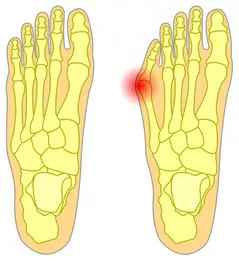
What is quintus varus?
Dr Simon Tournemine in Hauts-de-Seine (92)
Quintus varus, also known as a bunionette or tailor’s bunion, is a common deformity affecting the fifth toe. The little toe gradually curves inwards, creating a painful prominence along the outer border of the foot. Symptoms are mainly caused by friction between the bony prominence and footwear.
Quintus varus is often described as the equivalent of hallux valgus affecting the fifth toe, resulting in progressive deformity, discomfort, and difficulty wearing shoes.
Causes and risk factors for quintus varus
Specialist in Foot Surgery in Hauts-de-Seine (92)
Quintus varus can develop for several reasons.
A hereditary predisposition is common, and familial forms are frequently observed. Wearing high-heeled, narrow-fitting shoes may also contribute to the development of the deformity.
Abnormal foot alignment, including pes cavus (high-arched foot) and pes planus (flat foot), can increase the risk.
Certain traumatic injuries or previous surgery involving other toes may also promote the development of quintus varus.
Quintus Varus in Rueil-Malmaison
Foot Surgery in Hauts-de-Seine
Preventing quintus varus
Several everyday measures may help reduce symptoms and limit progression:
- maintain a healthy body weight to reduce pressure on the feet;
- wear soft, wide-fitting shoes with a rounded toe box to minimise friction;
- choose flat shoes and avoid high heels whenever possible;
- have corns, calluses and areas of thickened skin treated regularly by a podiatrist.
Symptoms of quintus varus
Quintus varus may occasionally remain painless, although it most commonly causes discomfort.
Pain usually develops while walking and is located over the bony prominence at the base of the little toe.
As the deformity rubs against footwear, calluses (areas of thickened skin) frequently develop. This repeated friction leads to inflammation of the fifth metatarsophalangeal joint, causing the area to become red, warm and painful.
As the deformity progresses, the mechanics of the entire forefoot become altered. Weight is transferred onto the adjacent toes, leading to painful pressure beneath the forefoot. Thickened skin and plantar calluses develop, while the neighbouring toes may gradually curl into painful claw toe deformities. Wearing standard footwear may eventually become increasingly difficult.
Diagnosis of quintus varus
Your consultation begins with a detailed medical history to identify the possible causes and risk factors associated with quintus varus. The impact of symptoms on daily activities, including pain and difficulty wearing shoes, is also carefully assessed.
Clinical examination identifies the painful areas of the foot, evaluates the severity of the fifth toe deformity, and assesses whether the adjacent toes are also affected.
Weight-bearing anteroposterior and lateral foot radiographs are then obtained. These allow precise assessment of the severity of the deformity, its effect on the neighbouring toes, the overall alignment of the foot, and any associated degenerative joint changes.
Treatment of quintus varus
Without treatment, quintus varus tends to progress gradually. The little toe becomes increasingly deviated, leading to secondary deformities of the neighbouring toes and worsening pain.
When podiatric care alone is no longer sufficient to relieve persistent pain or difficulties with footwear, surgical correction may be recommended.
The aim of surgery is to realign the fifth toe and remove the painful prominence at the fifth metatarsophalangeal joint, restoring a more normal foot shape, relieving pain, and improving comfort when wearing shoes.