
Knee replacement surgery (total or partial/unicompartmental) is an effective procedure to relieve pain caused by severe osteoarthritis (gonarthrosis). However, the ultimate success of the surgery largely depends on the recovery process.
How long does it take to walk normally again? When can you drive or return to sports? Here is a comprehensive guide to the stages of recovery following a knee replacement.
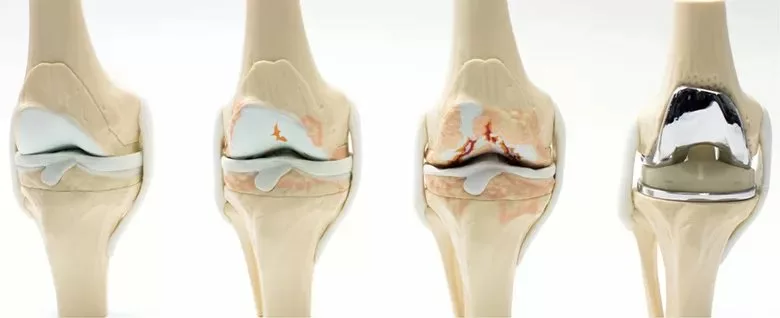
Recovery Timeline After Surgery
Every patient progresses at their own pace, but recovery generally follows a well-defined schedule.
The First Four Weeks: Independence and Healing
On the day of surgery, standing up and taking your first steps are accomplished with the medical team.
- Walking and Crutches: Moving around is done using crutches to secure weight-bearing.
- Range of Motion Goals: Efforts focus on achieving full knee extension and reaching at least 90° of flexion by the end of the first month.
- Daily Life: Simple daily tasks (getting up from a chair, moving around at home) are performed independently.
Months 1 to 3: Returning to Everyday Activities
This is the period when discomfort decreases significantly and the most noticeable progress occurs.
- Weaning off Crutches: Gradually stopping the use of crutches usually occurs between the 3rd and 6th week, once quadriceps control is solid and walking without a limp is achieved.
- Resuming Driving: As a general rule, driving after a knee replacement is feasible from 4 to 6 weeks onward, as soon as muscle control of the lower limb allows for safe emergency braking.
- Stairs: Climbing and descending stairs improve progressively thanks to muscle strengthening.
3 to 6 Months and Beyond: Functional Outcomes
By 3 months, most daily activities are resumed, though mild discomfort may occasionally persist. Tissue maturation continues for up to 1 year post-surgery to achieve a final result and a “silent,” forgotten knee in daily life.
Rehabilitation: The Key to a Mobile and Stable Knee
Knee rehabilitation begins immediately after surgery, either in a rehab center or at home with a physical therapist.
It relies on three priority pillars:
- Gaining Range of Motion: Working on extension (to avoid flexion contracture) and progressive flexion.
- Muscle Strengthening: Targeting primarily the quadriceps and hamstrings to stabilize the joint.
- Proprioception and Gait Training: Re-learning a smooth, balanced walking stride.
Warm and Swollen Knee After Surgery
It is very common to observe a warm and swollen knee during the first 2 to 4 months following the operation. This is a normal inflammatory reaction related to internal healing and rehabilitation exercises.
How to relieve these symptoms?
- Icing: Apply an ice pack (wrapped in a cloth) for 15 to 20 minutes, 3 to 4 times a day.
- Elevation: Elevate the leg at rest to promote lymphatic and venous drainage.
- Rest/Activity Balance: Pace your efforts: a knee that swells excessively by the end of the day often signals temporary overexertion.
Note: If warmth is accompanied by fever, spreading redness, or discharge from the incision, urgent medical advice is required.
Pain After Knee Replacement: What to Expect
It is normal to experience pain after receiving a knee replacement, especially during the first few weeks. Prostithetic surgery places significant demands on surrounding bone and muscle tissue, making postoperative discomfort an integral part of the healing process.
- During the First Month: Pain is primarily inflammatory and linked to superficial and deep tissue healing. It is effectively managed through a personalized pain protocol established upon discharge (analgesics, anti-inflammatories, regular icing). Moderate pain during rehabilitation exercises or at the end of the day is expected.
- Between 1 and 3 Months: Acute pain subsides, giving way to muscle soreness or a feeling of mechanical “stiffness,” particularly when standing up or after prolonged sitting.
- Long-Term Evolution: In the vast majority of cases, residual pain gradually diminishes until it completely disappears within 6 to 12 months.
With advances in pain management protocols and minimally invasive surgical techniques, pain control has significantly improved, allowing for faster recovery.
Sports and Knee Replacement: Which Activities Can You Resume?
The goal of a modern knee prosthesis is to allow you to return to an active lifestyle. However, activity selection should aim to preserve the implant over the long term.
Recommended Sports
Low-impact activities are strongly encouraged starting from the 3rd month:
- Cycling (stationary bike first, then road cycling): ideal for maintaining mobility without joint impact.
- Swimming (front crawl and backstroke preferred).
- Nordic Walking and Hiking on flat, regular terrain.
- Golf.
Sports to Avoid or Modify
Activities involving repeated impacts, hard landings, or sudden twisting/pivoting (soccer, singles tennis, running on hard surfaces) are discouraged, as they may accelerate wear on the prosthesis components.
Summary
The success of a knee replacement relies on teamwork between the surgeon, physical therapist, and patient. By adhering to the recovery milestones and maintaining appropriate physical activity, the vast majority of patients regain painless walking and an excellent quality of life within a few months