
Principles of Anterior Cruciate Ligament (ACL) Reconstruction
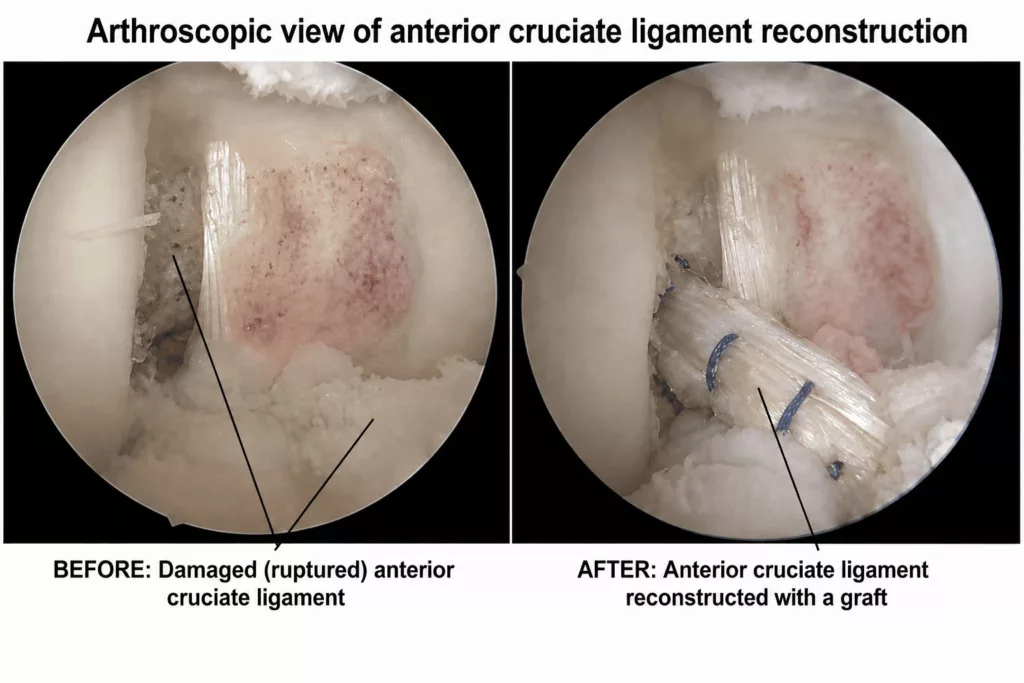
Anterior cruciate ligament (ACL) reconstruction is a procedure in which a tendon graft is used to replace the torn ACL. This graft is harvested from the hamstring tendons.
The graft is secured within bone tunnels using fixation devices (such as screws or staples). However, it takes approximately six months for the graft to transform into a strong ligament. Initially, the graft undergoes a period of biological vulnerability before progressively acquiring its definitive mechanical strength.
Rehabilitation must therefore be adapted to the biological healing and progressive strengthening of the graft.
Months 1 and 2
During the first two months, fixation of the ACL graft depends entirely on the surgical fixation devices, as natural bony integration has not yet occurred.
Rehabilitation remains cautious, with priority given to tissue healing, restoration of knee mobility and recovery of active quadriceps control. Walking can usually be resumed early, with progressive return to full weight-bearing. Crutches may be used during the initial postoperative period for comfort.
Months 3 and 4
By the third and fourth months, the graft has achieved satisfactory fixation but remains fragile while undergoing the process of ligamentisation.
Rehabilitation focuses on restoring mobility, function, movement patterns and protective neuromuscular reflexes. A gradual return to sports that do not place excessive stress on the ACL may be considered, including cycling, swimming and treadmill running.
Months 5 and 6
During the fifth and sixth months, the mechanical strength of the ACL graft improves significantly.
Rehabilitation becomes more dynamic, with endurance and strength training combined with proprioceptive exercises.
After 6 months
After six months, the graft has acquired its definitive mechanical strength.
Following clinical assessment, and with the agreement of both your physiotherapist and your surgeon, a return to sports that place significant demands on the ACL may be considered, including football, tennis, combat sports and skiing.
A return to competitive sport may require an additional 3 to 6 months, depending on the discipline.
Conclusion
Rehabilitation must follow the biological timeline of graft healing.
Rehabilitation Protocol Following ACL Reconstruction
Rehabilitation generally extends over approximately six months and is divided into five phases.
Phase 1: Healing (First 3 Weeks)
From the day of surgery until suture removal.
Objectives
Approximately three weeks are required for wound healing. During this period, knee swelling should progressively decrease and pain should resolve. The aim is to achieve active quadriceps control in full extension and 60° to 90° of knee flexion. Weight-bearing is resumed progressively.
Rehabilitation
- Cryotherapy using a cold therapy brace.
- Walking with progressive weight-bearing using crutches.
- Gentle muscle activation.
- Gentle manual mobilisation.
- Massage, muscle activation, cryotherapy and physiotherapy.
- Open-chain proprioceptive exercises.
- Electrical muscle stimulation to reduce muscle wasting.
Phase 2: Regaining Independence (Weeks 3 to 6)
Objectives
Between the third and sixth postoperative weeks, the goals are to regain full weight-bearing while walking and progressively restore knee range of motion.
Crutches are gradually discontinued so that, by approximately 45 days, the knee is no longer swollen or painful.
The objective is to achieve 120° of flexion and full extension (0°).
Rehabilitation
- Gait retraining.
- Restoration of joint mobility using manual and instrumental techniques.
- Progressive moderate muscle strengthening.
- Electrical muscle stimulation.
- Balance and proprioceptive exercises.
- Hydrotherapy and massage.
- Towards the end of this phase, cycling without resistance (provided range of motion is satisfactory) and treadmill walking.
Phase 3: Consolidation (45 Days to 3 Months)
Objective
To restore the patient’s confidence in the operated knee.
Muscle strengthening is progressively intensified. Proprioceptive training becomes the priority, together with movement re-education and endurance activities such as walking, cycling and step training.
Rehabilitation
- Co-contraction exercises performed at different knee flexion angles (such as leg press exercises).
- Hamstring strengthening with emphasis on power and contraction speed.
- Quadriceps strengthening using closed kinetic chain exercises and isometric extension exercises.
- Development of neuromuscular control and proprioception using wobble boards, balance boards and trampolines.
- Cardiovascular conditioning with cycling and step exercises.
- Introduction of light jogging on flat, even ground towards the end of this phase.
Phase 4: Athletic Rehabilitation (3 to 6 Months)
Objective
More demanding activities can progressively be introduced, both for strength and endurance. Running is added to the rehabilitation programme, while swimming and cycling remain the foundation of physical recovery.
Rehabilitation
- Progressive strengthening of all major muscle groups using resistance machines and leg press exercises.
- Isokinetic strengthening.
- Dynamic exercises incorporating jumping and stationary changes of direction.
- Progression of running with acceleration drills, front crawl swimming using fins and cycling.
- Progressive return to physical activity.
Contraindications
- Pivoting and contact sports remain contraindicated during this phase.
Phase 5: Return to Sport (After 6 Months)
Objective
After the sixth postoperative month, a return to pivoting and contact sports may be considered. This phase corresponds to sport-specific rehabilitation and may last from several weeks to several months depending on the sport practised.
A return to competitive sport may require an additional 3 to 6 months, depending on the sporting discipline.
Rehabilitation
- Comparative isokinetic testing.
- Intensive muscle strengthening.
- Relearning sport-specific movements.
- Progressive return to sport-specific training according to the sport and level of participation.
- Sport-specific functional assessment.
Conclusion
Techniques for anterior cruciate ligament reconstruction continue to evolve and have become increasingly reliable. Postoperative recovery has accelerated, and a better understanding of graft healing has made it possible to define its mechanical strength over time and adapt rehabilitation accordingly.
The rehabilitation protocol described above is intended as a general guide. It outlines the main principles of treatment but should always be individualised according to each patient’s recovery and the recommendations of their orthopaedic surgeon.