
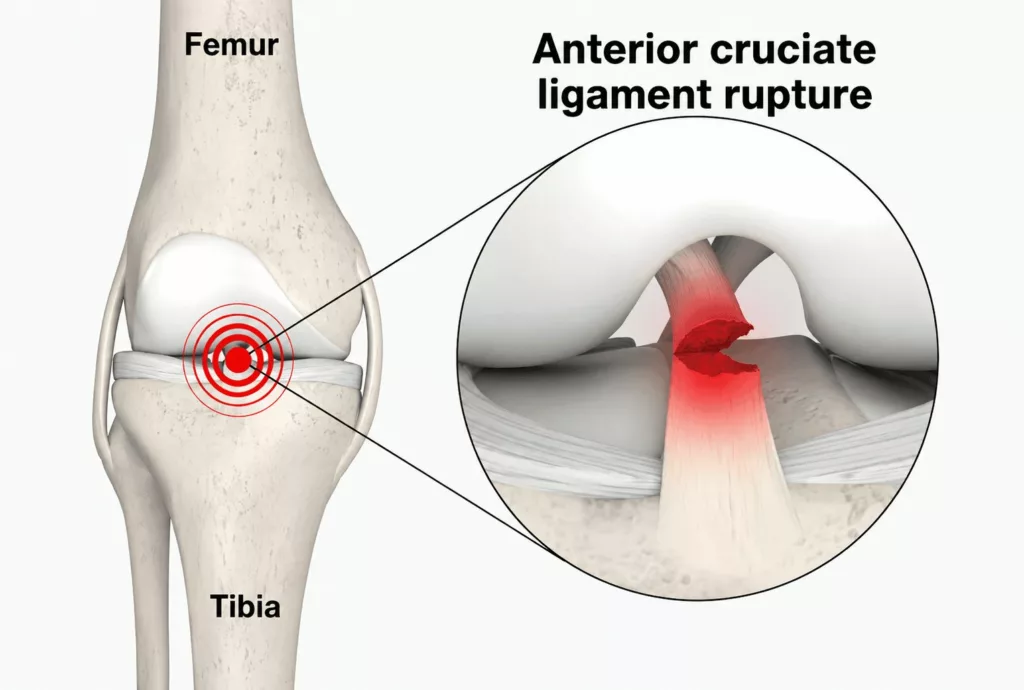
A cruciate ligament injury, particularly a tear of the anterior cruciate ligament (ACL), is one of the most common knee injuries among athletes, although it can also occur during everyday activities.
Following the diagnosis, one question almost always arises: is surgery necessary, or can the injury be managed successfully without an operation?
This article reviews the available treatment options, their respective advantages and limitations, to help you better understand current medical recommendations.
Understanding cruciate ligament injuries
The anterior and posterior cruciate ligaments are located at the centre of the knee and play a fundamental role in maintaining joint stability.
The anterior cruciate ligament (ACL) is by far the ligament most frequently injured. ACL ruptures typically occur following:
- a sudden twisting movement;
- an abrupt change of direction or pivot;
- direct contact during sports such as football, skiing or basketball.
Typical symptoms include a popping sensation at the time of injury, immediate pain, rapid swelling of the knee and a feeling of instability when attempting to walk or pivot.
The diagnosis is confirmed through a combination of clinical examination and magnetic resonance imaging (MRI).
Conservative treatment: Rehabilitation and activity modification
What does conservative treatment involve?
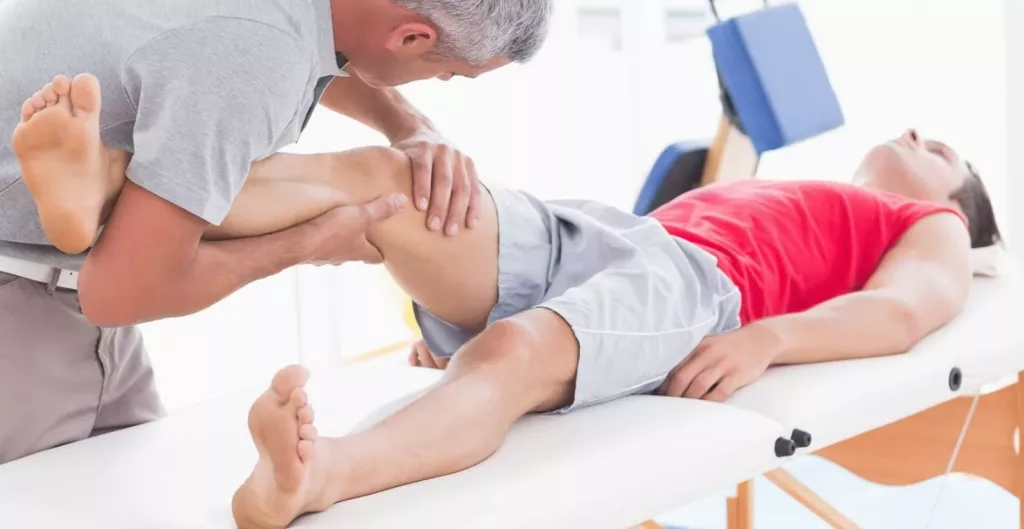
Conservative management is centred on a structured physiotherapy programme aimed at restoring knee function without surgery.
The objective is to strengthen the muscles surrounding the knee—particularly the quadriceps and hamstrings—to compensate for the loss of ligament stability.
Rehabilitation typically includes:
- proprioceptive training to improve balance and neuromuscular control;
- progressive muscle strengthening;
- modification of sporting activities, particularly avoiding sports involving pivoting movements and physical contact.
Who is conservative treatment suitable for?
Non-operative management is generally recommended for:
- patients with relatively low physical demands;
- individuals who do not participate in pivoting or contact sports;
- partial ACL tears or patients with minimal functional instability.
Advantages and limitations
Advantages
- Avoids surgery.
- Faster return to normal daily activities.
Limitations
- Persistent instability may occur during sporting activities.
- Ongoing instability may contribute to premature cartilage degeneration and an increased long-term risk of knee osteoarthritis.
Surgical treatment: ACL reconstruction
What does the operation involve?
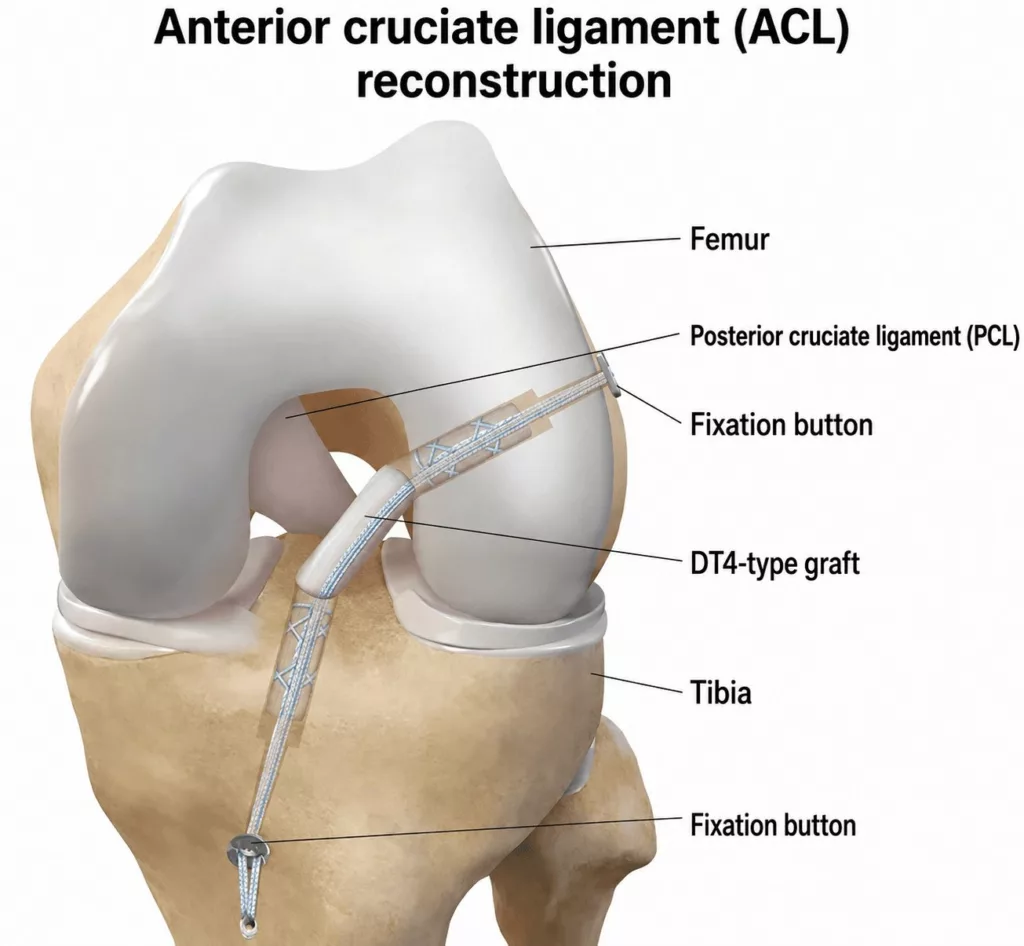
ACL reconstruction (ligament reconstruction or ligamentoplasty) consists of replacing the torn ligament with a tendon graft, most commonly harvested from the patellar tendon or the hamstring tendons.
The procedure is performed arthroscopically through small incisions and is followed by a structured rehabilitation programme lasting approximately six months, although return to certain sports may require longer.
Who is surgery recommended for?
ACL reconstruction is generally advised for patients who are:
- young and physically active;
- involved in sports requiring pivoting, cutting or physical contact;
- experiencing persistent instability despite appropriate rehabilitation.
Advantages and limitations
Advantages
- Superior long-term knee stability.
- Enables return to pivoting and contact sports.
- May reduce the risk of secondary meniscal injury and long-term osteoarthritis associated with recurrent instability.
Limitations
- Requires surgery.
- Rehabilitation is lengthy, with return to competitive sport generally taking 6 to 9 months, depending on the activity.
Surgery or conservative treatment: How is the decision made?
The most appropriate treatment depends on several individual factors.
These include:
- the patient’s age;
- activity level and sporting goals;
- the desire to return to pivoting or contact sports;
- the degree of knee stability following an initial rehabilitation programme.
Recent scientific evidence demonstrates that, in carefully selected patients, a well-conducted rehabilitation programme can provide functional outcomes comparable to surgery.
However, ACL reconstruction remains the preferred treatment for patients seeking to regain maximum knee stability for demanding sporting activities or who continue to experience instability despite rehabilitation.
Conclusion: An individualised treatment decision
There is no single answer to the question of whether an ACL rupture should be treated surgically.
The most appropriate treatment depends on each patient’s lifestyle, expectations, symptoms and clinical assessment.
- Conservative treatment is often suitable for patients with lower physical demands or those who do not participate in pivoting sports.
- ACL reconstruction is generally recommended for active individuals wishing to return to pivoting or contact sports, or for patients with persistent symptomatic instability despite appropriate rehabilitation.
In every case, assessment by an orthopaedic knee specialist, together with a physiotherapist, is essential to establish the treatment strategy best suited to your individual needs and long-term goals.