
Each knee contains two crescent-shaped menisci: the medial meniscus (inner meniscus) and the lateral meniscus (outer meniscus). Their distinctive shape and fibrocartilaginous, elastic structure enable them to absorb shock and stabilise the knee joint. Repetitive mechanical stress or an acute traumatic injury can lead to a meniscal tear.
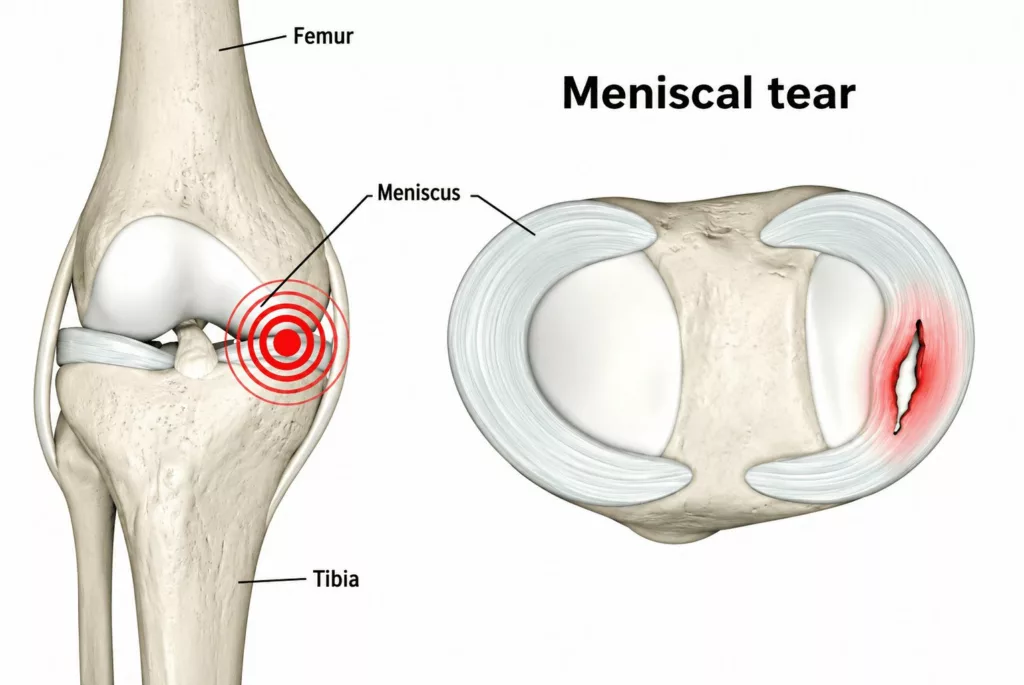
Three treatment options may be considered for a meniscal injury:
- Meniscectomy (removal of the damaged portion of the meniscus);
- Meniscal repair;
- Conservative treatment, including rest, non-steroidal anti-inflammatory drugs (NSAIDs) and corticosteroid injections.
The choice between these treatment options depends on:
- The patient’s age;
- Whether the tear is traumatic or degenerative;
- The morphology and stability of the tear as assessed on MRI.
Young patients (<40 years)
Traumatic meniscal tears are the most common in younger patients. They typically occur during sporting activities or heavy manual work. Movements involving deep knee flexion or twisting place the meniscus at greatest risk of injury.
Degenerative meniscal tears occurring without trauma are less common in younger patients. They may be associated with premature degeneration of the meniscus or reduced vascular supply.
In younger patients, every effort is made to preserve the meniscus. A meniscal repair is performed arthroscopically whenever possible to promote healing. Preserving the meniscus is essential in reducing the long-term risk of developing knee osteoarthritis.
However, certain tears located in poorly vascularised areas have little healing potential. In these situations, a meniscectomy is performed.
Older patients (>40 years)
Degenerative meniscal tears are the most common after the age of 40. They result from the natural ageing process of the meniscus and occur independently of any traumatic event. As the meniscus ages, it gradually loses its elasticity and resistance, making it more susceptible to spontaneous tearing.
These degenerative tears do not heal, which is why meniscal repair is generally not recommended after the age of 40.
Two treatment options are therefore considered:
- Arthroscopic meniscectomy, during which only the damaged portion of the meniscus is removed;
- Conservative treatment, consisting of activity modification, anti-inflammatory medication and corticosteroid injections.
For stable degenerative tears, where there is no detached or mobile meniscal fragment, conservative treatment is initially recommended, including activity modification, NSAIDs and corticosteroid injections. If symptoms persist despite appropriate medical treatment, a partial meniscectomy may then be considered.
By contrast, unstable degenerative tears with a mobile meniscal fragment often cause mechanical symptoms such as locking or instability of the knee, in addition to pain. These lesions generally respond poorly to conservative treatment, as medication cannot stabilise the displaced fragment. In such cases, a partial meniscectomy is usually recommended to remove the unstable meniscal fragment.
Conclusion
The treatment of a meniscal tear depends on both the patient’s age and the type of lesion.
In younger patients (<40 years), arthroscopic meniscal repair is recommended whenever possible. The aim is to preserve the meniscus and reduce the long-term risk of developing knee osteoarthritis.
In older patients (>40 years), treatment is generally conservative, except in the presence of an unstable meniscal fragment. In these cases, an arthroscopic partial meniscectomy is performed. After the age of 40, this procedure is associated with little or no additional progression of osteoarthritis.