
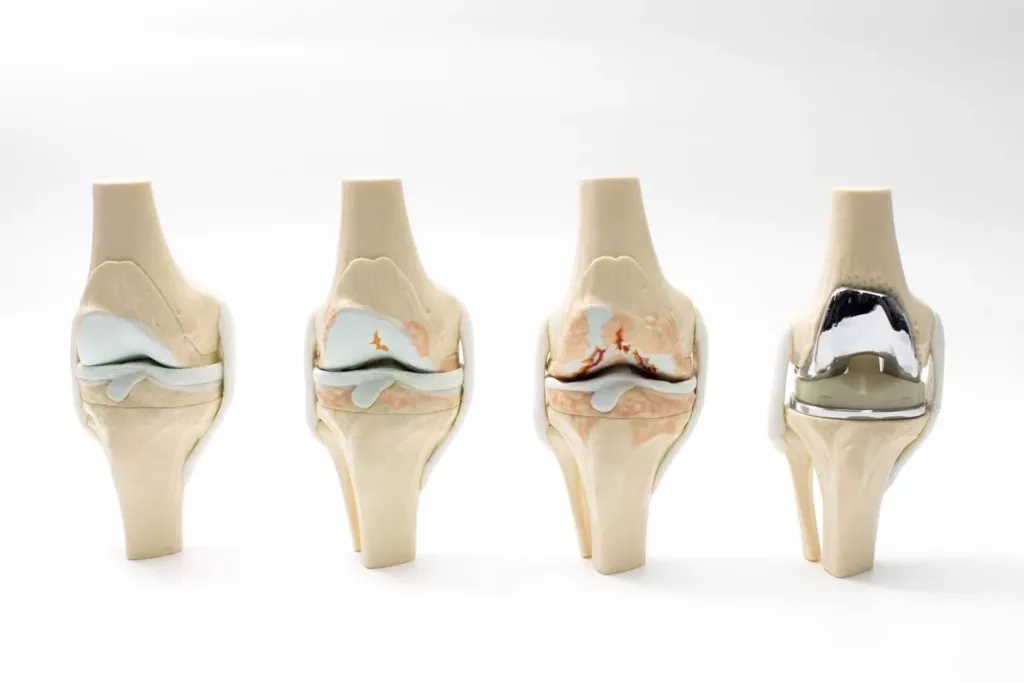
Undergoing a total knee replacement (total knee arthroplasty, TKA) is often life-changing for patients suffering from advanced knee osteoarthritis. Once pain has been relieved, one question inevitably follows:
“Which sports can I safely resume after a knee replacement?”
Contrary to common misconceptions, knee replacement surgery does not mark the end of an active lifestyle. On the contrary, regular physical activity is essential for both the longevity of your prosthesis and your overall health.
Not all sports, however, place the same demands on your new joint. This guide explains which activities are recommended, which should be approached with caution, and which are best avoided.
Why is sport important after total knee replacement?
The days when prolonged rest was recommended after joint replacement are long gone.
Today, orthopaedic surgeons recognise that regular exercise is beneficial—and often essential—for several reasons.
Building muscle strength
A knee replacement relies on strong surrounding muscles, particularly the quadriceps and hamstrings, to maintain stability and optimise function.
Maintaining bone health
Weight-bearing exercise stimulates bone remodelling and supports osseointegration, helping to maintain secure fixation of the implant.
Weight management
Excess body weight remains one of the principal factors affecting the longevity of a knee prosthesis. Regular physical activity helps maintain a healthy body weight, reducing mechanical stress on the implant.
Returning to sport: When can you start?
Recovery requires patience. Returning to sport should always follow a gradual progression based on healing, muscle recovery and your surgeon’s recommendations.
Months 1 to 2
The focus is on:
- walking;
- stationary cycling without resistance;
- physiotherapy to restore knee movement and strength.
Months 3 to 6
Low-impact sporting activities can usually be resumed, provided your surgeon is satisfied with your progress.
After 6 months
If muscle strength, balance and proprioception have recovered satisfactorily, a wider range of recreational activities may be considered.
Recommended sports: Green light
These low-impact activities provide excellent cardiovascular and muscular benefits while placing minimal stress on the artificial joint.
1. Walking and hiking
Walking remains the cornerstone of recovery and should become part of your daily routine.
Expert advice
Nordic walking is particularly beneficial. Walking poles reduce the load transmitted through the knees by helping distribute body weight to the upper limbs. During the early months, steep descents and uneven terrain should be approached with caution.
2. Cycling
Cycling is one of the best exercises following knee replacement.
It improves endurance, strengthens the muscles and allows effective cardiovascular training without excessive impact on the joint.
Practical tip
Begin on a stationary bicycle before progressing outdoors. When cycling outside, choose relatively flat terrain and adjust the saddle height appropriately to avoid excessive knee flexion, which may initially be uncomfortable.
3. Swimming and water-based exercise
The buoyancy of water significantly reduces the load placed on the knee, making swimming an excellent option during rehabilitation.
Please note
Front crawl and backstroke are generally preferred. Breaststroke may place rotational stress on the knee and can be less comfortable for some patients.
4. Golf
Golf is fully compatible with a knee replacement.
Soft-spiked golf shoes are recommended to reduce rotational forces on the knee during the swing. During the first few rounds, using a golf buggy may help reduce fatigue.
Sports that may be possible with caution: Amber light
These activities may be appropriate for experienced participants who practised them before surgery and have regained good muscle strength and balance.
They are generally not recommended for beginners after knee replacement.
Tennis
Doubles tennis is usually preferable to singles because it involves fewer sudden accelerations, lateral movements and rapid changes of direction.
Alpine skiing
Patients with previous skiing experience may return to skiing on well-groomed slopes in favourable snow conditions.
Smooth, controlled turns are recommended. Learning to ski after knee replacement is generally discouraged because of the increased risk of falls and fractures around the prosthesis.
Ballroom dancing
Ballroom dancing is an excellent activity for maintaining coordination and fitness, provided it does not involve repeated jumping or excessive twisting movements.
Sports to avoid: Red light
The objective is to minimise wear of the polyethylene bearing surface and reduce the risk of implant loosening or periprosthetic fracture.
High-impact and contact sports are therefore generally discouraged.
Running and jogging
Each running stride subjects the knee replacement to forces several times greater than body weight, accelerating mechanical wear of the implant.
Contact team sports
Sports such as rugby, handball and basketball carry significant risks of direct impact, twisting injuries and fractures around the prosthesis.
Combat sports
Judo, karate and wrestling are generally not recommended because of the risk of falls and high-impact trauma.
Tai Chi, however, is an excellent exception, as it improves balance, coordination and stability.
Squash
The repeated abrupt stops and rapid changes of direction place excessive rotational stress on the artificial knee.
Four expert recommendations for long-term success
To maximise both your recovery and the longevity of your knee replacement, follow these key principles.
Wear appropriate footwear
Choose supportive shoes with effective shock absorption—even for walking—to minimise impact forces transmitted to the knee.
Listen to your knee
Mild discomfort during the early stages of recovery is normal.
However, significant pain or swelling after exercise should not be ignored. Applying ice after physical activity may help reduce inflammation.
Never skip your warm-up
An operated knee requires a gradual increase in activity before exercise. Allow 10 to 15 minutes for gentle mobility and muscle activation before starting sport.
Continue proprioception exercises
The balance exercises learned during physiotherapy remain valuable long after surgery. Good proprioception reduces the risk of falls and helps protect your knee replacement.
Conclusion: Keep Moving to Stay Healthy
The answer to the question “Which sports can I practise after a total knee replacement?” is reassuring.
Most recreational activities remain entirely compatible with modern knee arthroplasty. The purpose of surgery is to restore your mobility and quality of life—not to limit your activity.
By favouring regular low-impact exercise, such as cycling, swimming, walking or golf, you can protect your artificial knee while enjoying all the physical and mental benefits of an active lifestyle.
As always, your return to sport should be planned in close consultation with your orthopaedic surgeon, who can provide personalised advice based on your implant, your recovery and your sporting objectives.