
A knee replacement is one of the most effective surgical treatments for patients suffering from disabling knee pain caused by advanced joint degeneration. But how do you know when the time is right to consider surgery?
Understanding the signs that indicate a knee replacement may be appropriate is essential for restoring mobility, relieving pain and improving quality of life.
What is a knee replacement?
A knee replacement, also known as knee arthroplasty, is a procedure that replaces part or all of the damaged joint surfaces affected by knee osteoarthritis.
The primary objectives of surgery are to:
- relieve pain;
- restore joint function;
- improve mobility;
- enable patients to return to their everyday activities.
There are two main types of knee replacement.
Total knee replacement
A total knee replacement (total knee arthroplasty, TKA) replaces all of the damaged cartilage surfaces within the knee joint.
Partial knee replacement
A partial knee replacement (unicompartmental knee arthroplasty, UKA) replaces only the affected compartment of the knee, most commonly the medial (inner) compartment, while preserving the healthy portions of the joint.
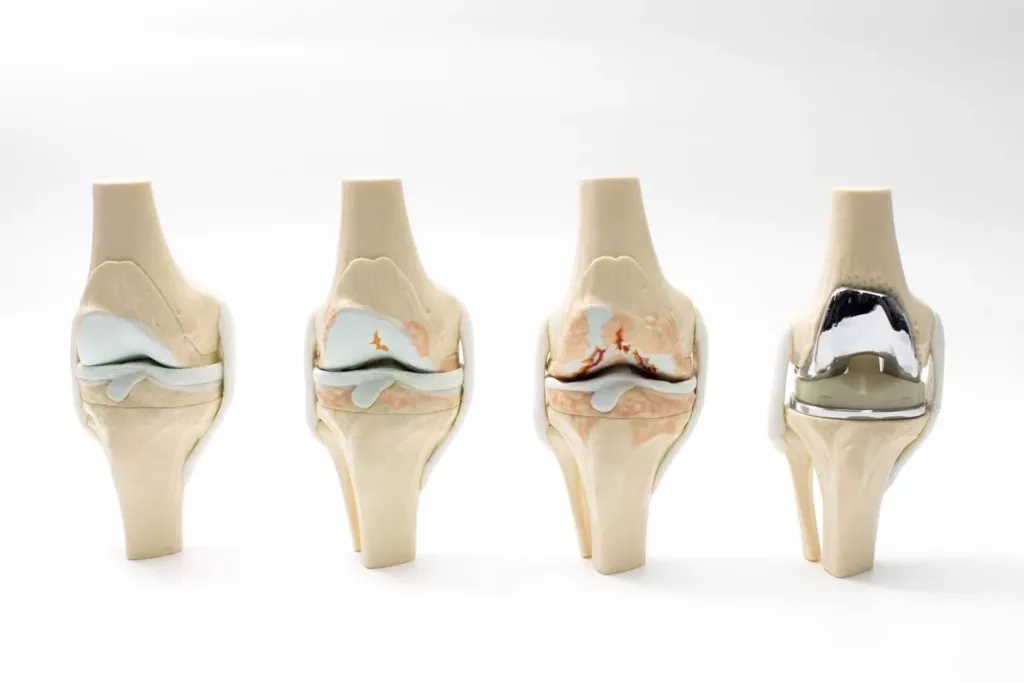
When should knee replacement be considered?
1. When pain becomes persistent and disabling
Persistent knee pain that occurs daily, continues at rest or disrupts sleep is often a sign of advanced joint degeneration.
When pain significantly affects everyday life despite appropriate treatment, knee replacement may become the most effective long-term solution.
2. When mobility is severely reduced
Difficulty climbing stairs, walking only short distances or rising from a chair are common signs that knee function has deteriorated.
When these limitations progressively reduce independence, knee replacement can restore mobility and improve quality of life.
3. When conservative treatment is no longer effective
Before surgery is considered, several non-operative treatments are usually recommended, including:
- anti-inflammatory medication;
- corticosteroid or hyaluronic acid injections;
- physiotherapy;
- weight management;
- knee braces or orthotic supports.
If pain persists despite appropriate conservative treatment, knee replacement surgery often becomes the most appropriate option.
4. When the knee becomes significantly deformed
As osteoarthritis progresses, the knee may gradually lose its normal alignment, leading to deformities such as bow legs (varus) or knock knees (valgus).
When these deformities become symptomatic and interfere with walking or daily activities, knee replacement surgery can restore alignment, improve stability and provide more comfortable walking.
What is the ideal age for knee replacement?
There is no specific age at which knee replacement becomes appropriate.
Most procedures are performed between the ages of 60 and 80 years, but younger patients may also benefit when:
- pain is severe;
- quality of life is significantly affected;
- conservative treatments have failed.
Thanks to advances in implant design, modern knee prostheses frequently provide 20 years or more of reliable function, making surgery a suitable option for appropriately selected younger patients.
What are the benefits of knee replacement?
For most patients, knee replacement offers significant improvements in both comfort and function.
The principal benefits include:
- complete or substantial relief of knee pain;
- restoration of joint mobility and reduction of stiffness;
- correction of deformity and realignment of the lower limb;
- return to recreational activities such as walking, cycling, swimming and, for selected patients, skiing.
Successful long-term outcomes also depend on dedicated postoperative rehabilitation and regular follow-up with your orthopaedic surgeon.
Conclusion
Deciding to undergo a knee replacement is an important medical decision that should be made following careful assessment by an orthopaedic specialist.
When pain becomes disabling, mobility progressively declines and conservative treatment no longer provides adequate relief, knee replacement surgery frequently offers the most effective solution for restoring function and improving quality of life.
A comprehensive consultation with your orthopaedic surgeon will determine whether knee replacement is the most appropriate treatment for your individual condition and expectations.