
Ankle Sprain and Chronic Ankle Instability in Hauts-de-Seine
Ankle Surgery
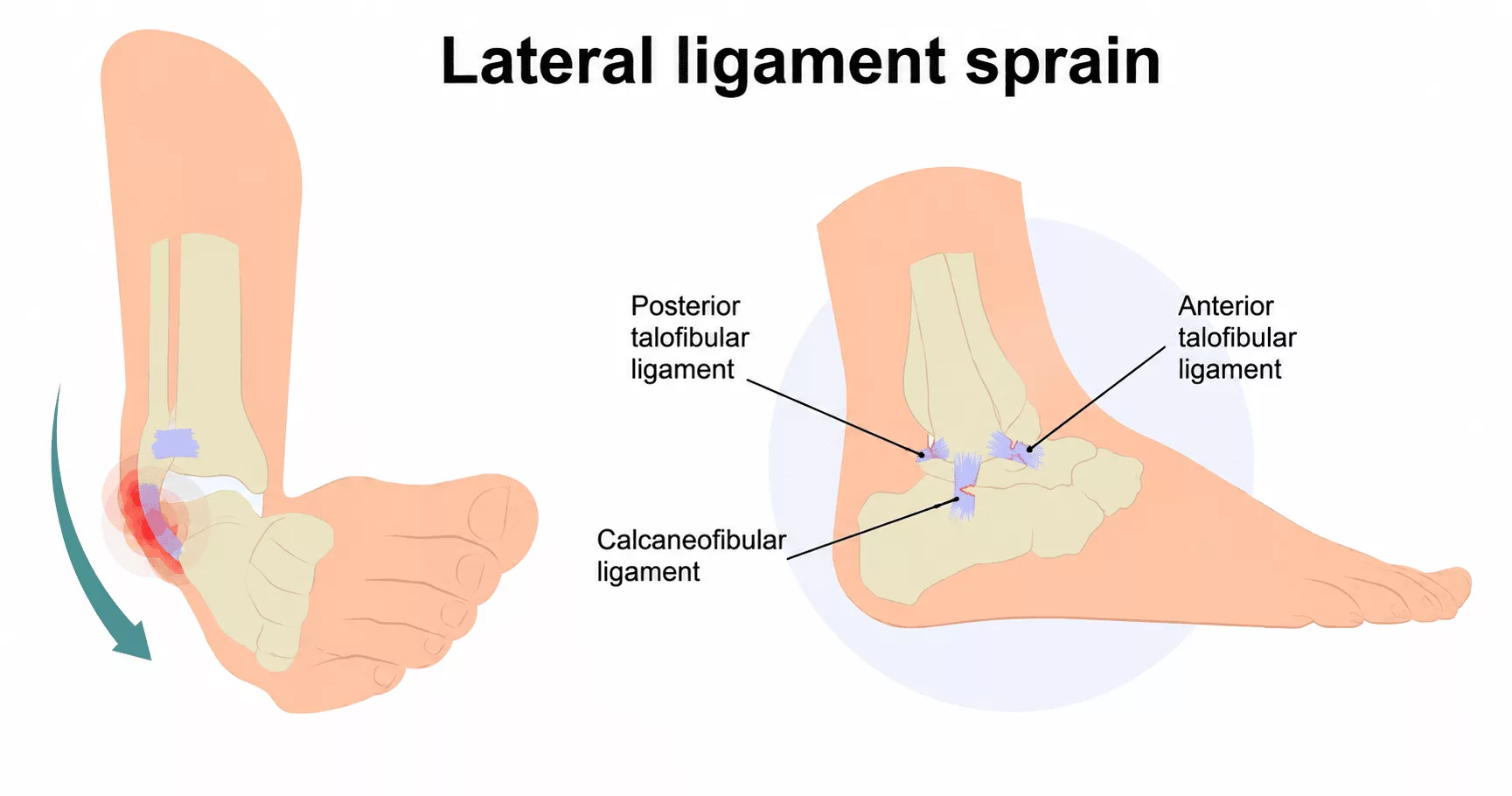
What Are an Ankle Sprain and Chronic Ankle Instability?
Dr Simon Tournemine in Hauts-de-Seine (92)
An ankle sprain is a partial or complete tear of one or more ankle ligaments following a traumatic injury. It is the most common ligament injury, accounting for approximately 6,000 medical consultations every day in France.
The ankle is stabilised by three ligament complexes:
- The lateral ligament complex, composed of the anterior talofibular ligament (ATFL), the calcaneofibular ligament (CFL) and the posterior talofibular ligament (PTFL);
- The medial ligament complex, also known as the deltoid ligament;
- The anterior and posterior tibiofibular ligaments, which stabilise the syndesmosis between the tibia and fibula.
Approximately 90% of ankle sprains involve the lateral ligament complex and may vary in severity:
- Mild sprain: simple stretching of a ligament without tearing;
- Moderate sprain: partial ligament tear;
- Severe sprain: complete rupture of one or more ligaments.
Causes and Risk Factors for Ankle Sprains and Chronic Ankle Instability
Ankle Surgery Specialist in Hauts-de-Seine (92)
An ankle sprain most commonly occurs following an inversion injury, when the foot rolls inwards during a misstep. This mechanism typically results in tearing of the lateral ankle ligaments.
Injuries involving the medial ligament complex or the tibiofibular syndesmosis are much less common. They usually result from a forced eversion injury, when the foot twists outwards, or from high-energy trauma such as a fall from height or a significant sporting injury during activities such as football or skiing.
Several factors increase the risk of sustaining an ankle sprain:
- participation in sports requiring rapid changes of direction, including football, basketball and tennis;
- walking or running on uneven terrain, such as during hiking or trail running;
- unstable or inappropriate footwear, including high-heeled shoes;
- certain foot morphologies, particularly a cavus (high-arched) foot.
Ankle Sprain and Chronic Ankle Instability in Rueil-Malmaison
Ankle Surgery in Hauts-de-Seine
Symptoms of an Ankle Sprain and Chronic Ankle Instability
Mild Ankle Sprain
In a mild sprain, one of the lateral ligaments is stretched without tearing or avulsion.
Pain and swelling are generally mild to moderate, and ankle mobility remains largely preserved.
Moderate Ankle Sprain
A moderate sprain involves tearing of one of the lateral ligaments, while another ligament may be stretched or partially torn. The ligament injury is therefore incomplete.
Pain is usually severe. The ankle becomes unstable, swollen and bruised because of bleeding from the torn ligament. Weight-bearing is painful and may sometimes be impossible.
Severe Ankle Sprain
A severe sprain is characterised by complete rupture of the lateral ligament complex.
Pain is immediate and intense. Patients experience marked ankle instability, significant loss of mobility, pronounced swelling and extensive bruising over the outer aspect of the ankle.
Preventing Ankle Sprains and Chronic Ankle Instability
Maintaining good ankle strength and flexibility helps reduce the risk of ankle sprains.
A thorough warm-up before sporting activity, regular strengthening and stretching exercises, together with footwear that is appropriate for the activity being performed, all contribute to lowering the risk of injury.
Diagnosis of an Ankle Sprain and Chronic Ankle Instability
The consultation begins with a detailed history to establish how the injury occurred and to assess symptoms such as pain, instability, locking or abnormal sensations within the ankle.
Your surgeon will also ask about the number of previous ankle sprains, their frequency, the type of sport practised and your level of physical activity.
Clinical examination assesses both ankle stability and range of motion. All three ligament complexes are evaluated, while associated injuries, particularly fractures or other bone lesions, are also investigated.
Imaging studies are routinely performed.
Standard X-rays are obtained to identify associated fractures or indirect signs of ligament injury.
Magnetic resonance imaging (MRI) is the reference examination for assessing ankle ligament injuries, allowing accurate visualisation of the damaged ligaments and determination of the severity of the injury.
Treatment of an Ankle Sprain and Chronic Ankle Instability
Regardless of the severity of the sprain, the acute painful phase generally settles over several weeks. Swelling gradually subsides and normal activities can progressively be resumed.
However, depending on the severity of the ligament injury, some patients continue to experience persistent pain or chronic ankle instability, leading to recurrent ankle sprains. These symptoms may interfere with daily activities, particularly movements involving changes of direction, and may prevent a return to sporting activities.
Treatment varies according to the severity of the injury and the ligaments involved. A specialist assessment is essential to establish an accurate diagnosis and determine the most appropriate management.
For most mild ankle sprains, surgery is not required because the ligaments are able to heal naturally. Treatment includes early weight-bearing as tolerated, pain relief, anti-inflammatory medication, regular icing and physiotherapy. A functional ankle brace is often recommended to facilitate a safe and early return to activity.
For severe ankle sprains, temporary immobilisation may be necessary and surgical treatment may be recommended to restore ankle stability. This procedure is known as ankle ligament reconstruction (ligamentoplasty).
The decision to proceed with surgery depends on several factors, including symptom severity, the extent of ligament injury, patient age, occupation, sporting level and functional expectations. The most appropriate treatment should be discussed individually with your orthopaedic surgeon.