
Achilles Tendon Repair in Hauts-de-Seine
Ankle Surgery
What is Achilles tendon repair?
Dr Simon Tournemine in Hauts-de-Seine (92)
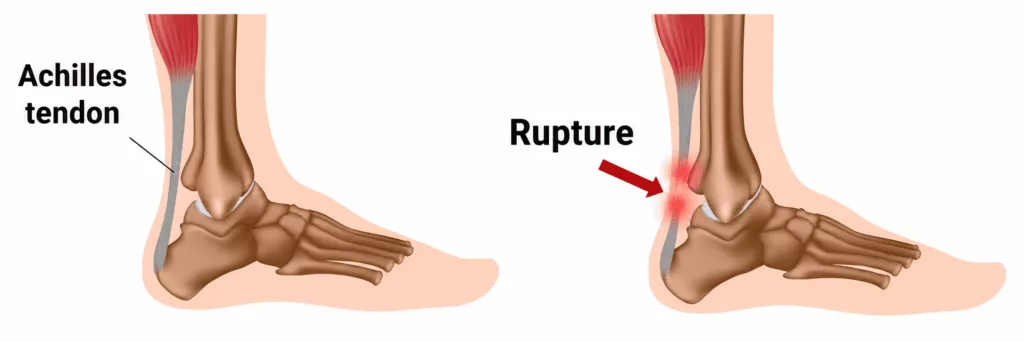
The Achilles tendon connects the calf muscles (triceps surae) to the heel bone (calcaneus). When the calf muscles contract, they pull on the tendon, producing plantar flexion of the ankle, which is essential for walking, propulsion and running. Although it is the strongest tendon in the human body, it may rupture following a sudden forceful contraction of the calf muscles or excessive stretching during a fall. Most ruptures occur within the midsubstance of the tendon, although they may occasionally occur at its insertion on the calcaneus.
Patients often describe hearing or feeling a sudden “snap” or tearing sensation at the back of the heel at the moment of rupture. This is followed by pain in the lower calf that may radiate down the leg. Bruising rapidly develops, and standing on tiptoe becomes impossible. Although walking often remains possible, it is associated with significant weakness of the ankle, which frequently leads patients to underestimate the severity of the injury and delay seeking specialist assessment.
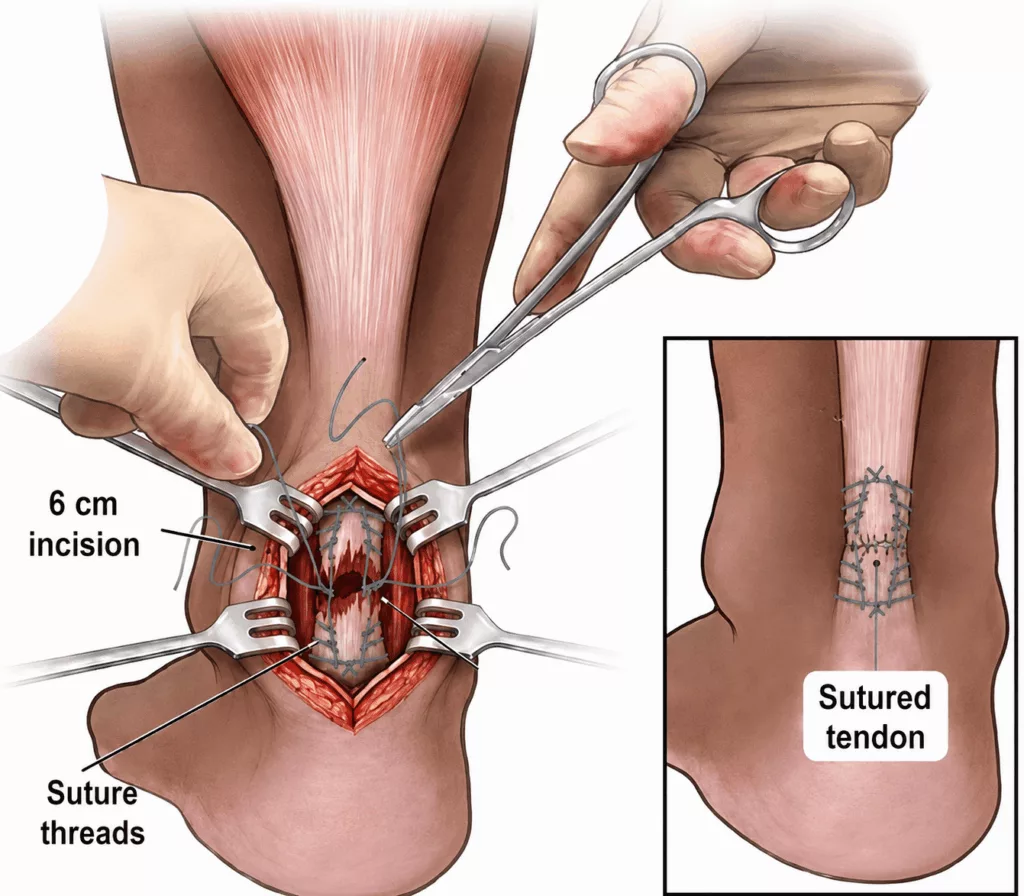
Surgical treatment consists of suturing the two ruptured ends of the tendon together to allow healing in their normal anatomical position.
Achilles Tendon Repair Procedure
Specialist in Ankle Surgery in Hauts-de-Seine (92)
An incision approximately 8 to 10 cm in length is made directly over the tendon. The two tendon ends are carefully identified and repaired using strong, high-tensile sutures. At the end of the procedure, the ankle is immobilised in an equinus plaster cast.
The operation takes approximately 30 minutes and is performed under either general anaesthesia or regional anaesthesia, during which only the foot is anaesthetised. The choice of anaesthetic technique will be discussed with your anaesthetist during your preoperative consultation.
This procedure is performed as day-case surgery, allowing you to return home on the day of the operation.
Achilles Tendon Repair in Rueil-Malmaison
Ankle Surgery in Hauts-de-Seine
Why undergo Achilles tendon repair and what are its benefits?
An untreated Achilles tendon rupture results in permanent loss of tendon function. If the tendon is not repaired promptly, the two ends progressively retract and can no longer heal together. Patients may still be able to walk, but significant calf weakness develops, making running and sporting activities impossible.
Two treatment options are available: conservative management and surgical repair.
Conservative treatment consists of immobilisation in an equinus plaster cast without weight-bearing for four weeks, followed by progressive weight-bearing in a walking boot fitted with gradually reducing heel wedges for a further two months. The risk of Achilles tendon re-rupture following conservative treatment is approximately 15%.
Surgical treatment consists of repairing the tendon by suturing the two ruptured ends together. This is followed by four weeks of immobilisation in an equinus plaster cast without weight-bearing, then progressive weight-bearing in a walking boot with gradually reducing heel wedges for a further two months.
The risk of tendon re-rupture following surgical repair is less than 5%, although the risk of surgical complications, including infection and skin necrosis, ranges between 1% and 3%.
The choice between conservative and surgical treatment should be discussed with your surgeon and depends on several factors, including your age, sporting activity and associated medical conditions.
Postoperative care and rehabilitation following Achilles tendon repair
Pain management is carefully monitored after surgery to ensure maximum comfort and facilitate early rehabilitation. Anticoagulant medication is prescribed throughout the immobilisation period to reduce the risk of deep vein thrombosis.
The foot and ankle remain immobilised in an equinus plaster cast for one month. During this period, walking with two crutches is permitted without weight-bearing on the operated limb.
After one month, the plaster cast is removed and replaced with a walking boot fitted with progressively reducing heel wedges for a further two months, allowing a gradual return to weight-bearing.
Physiotherapy begins after removal of the immobilisation, approximately one month after surgery, with the aim of restoring calf muscle strength, ankle flexibility and normal function.
Driving is generally possible from six weeks after surgery, while sporting activities may gradually resume after approximately three months.
Patients return home on the day of surgery.
These recovery times are provided as a guide and may vary depending on individual healing and rehabilitation progress.
Long-term clinical and radiographic follow-up remains essential to monitor tendon healing and detect any potential complications.
Risks and complications of Achilles tendon repair
Every precaution is taken to ensure the safest possible outcome. Nevertheless, as with any surgical procedure, complications, although uncommon, may occur.
Potential complications include:
- Deep vein thrombosis (DVT) and pulmonary embolism: uncommon complications minimised through one month of anticoagulant treatment.
- Exacerbation of pre-existing medical conditions: such as heart failure or diabetes. Careful postoperative monitoring is provided by the anaesthetic team.
- Infection (risk below 1%): this may require further surgery to clean the surgical site, followed by antibiotic treatment.
- Haematoma: postoperative bleeding may lead to the formation of a haematoma, which may occasionally require drainage or, rarely, blood transfusion.
- Injury to small sensory nerve branches: this uncommon complication may cause reduced sensation in certain areas of the ankle or foot.
- Tendon re-rupture: the risk depends on the treatment method employed.
- Ankle stiffness: this may occur if postoperative rehabilitation is not carried out appropriately.
- Complex Regional Pain Syndrome (CRPS): a rare and poorly understood painful inflammatory condition that may last several months, or occasionally years, requiring specialised pain management, rehabilitation and further investigations. Its occurrence, progression and long-term consequences remain unpredictable.
These represent the principal recognised risks, although this list is not exhaustive. Other rare or exceptional complications may occur. Not every possible complication can be anticipated, and these have been explained and discussed with you. Your surgeon remains available to answer any questions regarding your individual circumstances.
Results of Achilles tendon repair
An untreated Achilles tendon rupture inevitably leads to permanent loss of tendon function. Without repair, the tendon ends retract and are unable to heal together. Although walking often remains possible, patients experience marked calf weakness together with an inability to run or perform high-demand physical activities.
Surgical repair aims to restore tendon continuity, allowing recovery of normal ankle strength, mobility and function, with the goal of returning to sporting activities.
The decision between conservative treatment and surgical repair should always be made on an individual basis following discussion with your surgeon, taking into account factors such as age, associated medical conditions and sporting expectations.