
Synovial Cyst in Hauts-de-Seine

Foot Surgery

What is a synovial cyst?

Dr Simon Tournemine in Hauts-de-Seine (92)

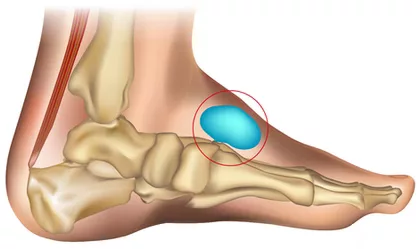
A synovial cyst of the foot is a soft tissue swelling that appears as a lump beneath the skin and is filled with a thick, jelly-like fluid known as synovial fluid.

It most commonly develops on the dorsum of the foot or around the toes.

A synovial cyst is a benign (non-cancerous) condition with no aggressive behaviour. Its natural course is unpredictable. Some cysts disappear spontaneously within the first few months, whereas others gradually enlarge, persist and eventually become painful or interfere with daily activities.

Causes and risk factors for a synovial cyst

Specialist in Foot Surgery in Hauts-de-Seine (92)

Synovial cysts of the foot are common and may occur at any age, although they are most frequently diagnosed in young adults between 20 and 40 years of age.

They are thought to be promoted by recurrent ankle sprains and repeated foot injuries, which weaken the joint capsule and lead to the formation of cysts filled with synovial fluid.

When located around the toes, synovial cysts most commonly arise from the tendon sheath.

Synovial Cyst in Rueil-Malmaison

Foot Surgery in Hauts-de-Seine

Although synovial cysts are often only mildly symptomatic, they may become both cosmetically and functionally troublesome as they enlarge.

A growing cyst may compress neighbouring anatomical structures, including tendons, nerves and blood vessels, resulting in reduced mobility, pain and discomfort caused by friction against footwear.

Clinical examination identifies a soft, subcutaneous swelling and assesses the surrounding anatomical structures, including the tendons, nerves and blood vessels, to ensure that they remain unaffected.

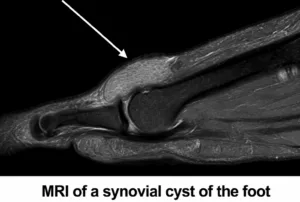
Magnetic resonance imaging (MRI) is performed to confirm the diagnosis and to exclude other conditions that may present with a similar appearance.
Treatment is not always necessary.

If the cyst is painless and well tolerated, simple observation is often appropriate, particularly as some synovial cysts resolve spontaneously within a few months.

When the cyst becomes symptomatic or troublesome, two treatment options may be considered:

  • aspiration with or without corticosteroid injection;
  • surgical excision of the cyst.

The most appropriate treatment should be discussed on an individual basis with your surgeon.