
Anterior Cruciate Ligament (ACL) Tear in Hauts-de-Seine
Knee Conditions
What Is an Anterior Cruciate Ligament (ACL) Tear?
Dr Simon Tournemine in Hauts-de-Seine (92)
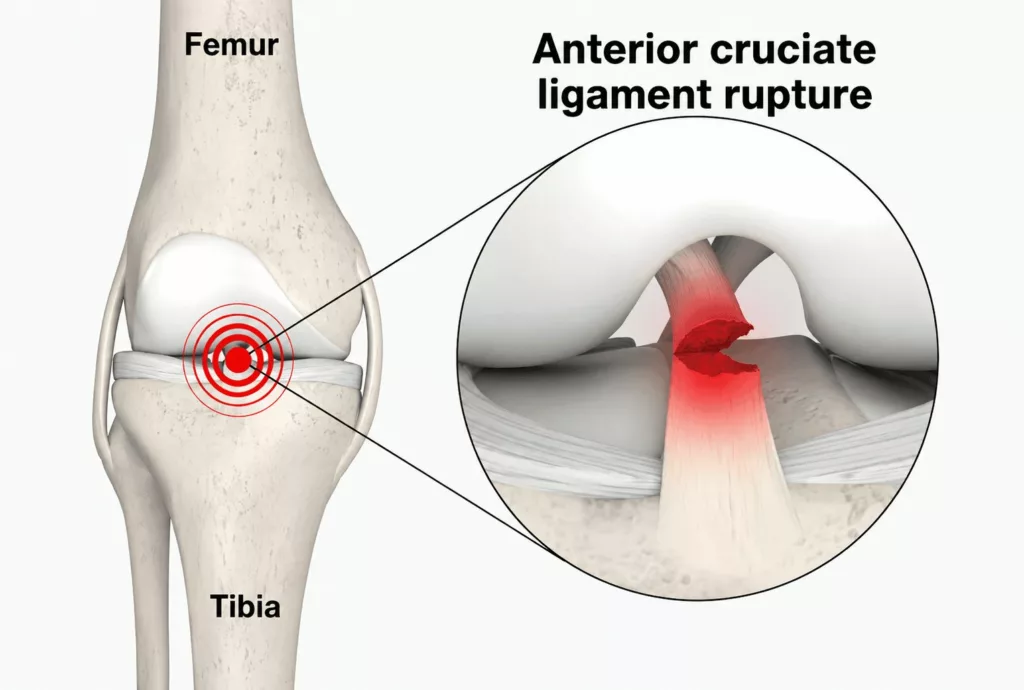
An anterior cruciate ligament (ACL) tear is one of the most common knee injuries and typically occurs during sporting activities involving a twisting movement of the knee. It is particularly frequent in sports such as football, rugby, skiing and combat sports.
The anterior cruciate ligament is located at the centre of the knee joint, within the intercondylar notch, where it connects the femur to the tibia. Its primary role is to stabilise the knee by preventing excessive forward movement of the tibia relative to the femur, while also controlling excessive rotational movements of the leg.
When excessive force is applied to the knee, the ACL may tear either partially or completely. This injury results in immediate pain and leads to instability of the knee joint.
Causes and Risk Factors for an Anterior Cruciate Ligament (ACL) Tear
Knee Surgery Specialist in Hauts-de-Seine (92)
ACL tears are particularly common in athletes, with an estimated incidence of approximately 1 in 3,000 individuals. The injury usually occurs following trauma, most frequently during a twisting movement of the knee while the foot remains firmly planted on the ground.
Sports involving rapid changes of direction, pivoting movements and physical contact carry the highest risk of ACL injury. These include football, rugby, skiing and combat sports.
Anterior Cruciate Ligament (ACL) Tear in Rueil-Malmaison
Knee Surgery in Hauts-de-Seine
Symptoms of an Anterior Cruciate Ligament (ACL) Tear
Many patients report hearing or feeling a distinct “pop” inside the knee at the time of injury, followed by immediate pain. Continuing sporting activity is usually impossible, and the knee rapidly becomes swollen because bleeding occurs within the joint following rupture of the ligament (haemarthrosis).
Although this acute and painful phase generally settles over the following weeks, with swelling gradually resolving and everyday activities progressively becoming easier, the natural progression of an ACL tear remains unfavourable. The torn ligament is unable to heal spontaneously. As a result, patients frequently experience persistent knee instability and a feeling of insecurity during daily activities. Movements involving pivoting or sudden changes of direction often become difficult, making a return to sport increasingly challenging.
Preventing an Anterior Cruciate Ligament (ACL) Tear
Maintaining good knee flexibility together with adequate muscle strength helps reduce the risk of ACL injury. A thorough warm-up before sporting activity and regular muscle-strengthening exercises are also important components of injury prevention.
Diagnosis of an Anterior Cruciate Ligament (ACL) Tear
The consultation begins with a detailed medical history to establish the mechanism of injury and assess the patient’s symptoms, including pain, the sensation of a pop, locking episodes and knee instability. The type of sport practised and the patient’s level of sporting activity are also taken into consideration.
Clinical examination focuses on assessing knee stability. The Lachman test and the anterior drawer test are performed to identify abnormal forward movement of the tibia beneath the femur. Rotational instability is also evaluated using the pivot shift test.
The remaining stabilising structures of the knee, including the posterior cruciate ligament (PCL) and the collateral ligaments, are systematically examined. Associated injuries, particularly meniscal tears, are also investigated, as they commonly occur alongside ACL ruptures.
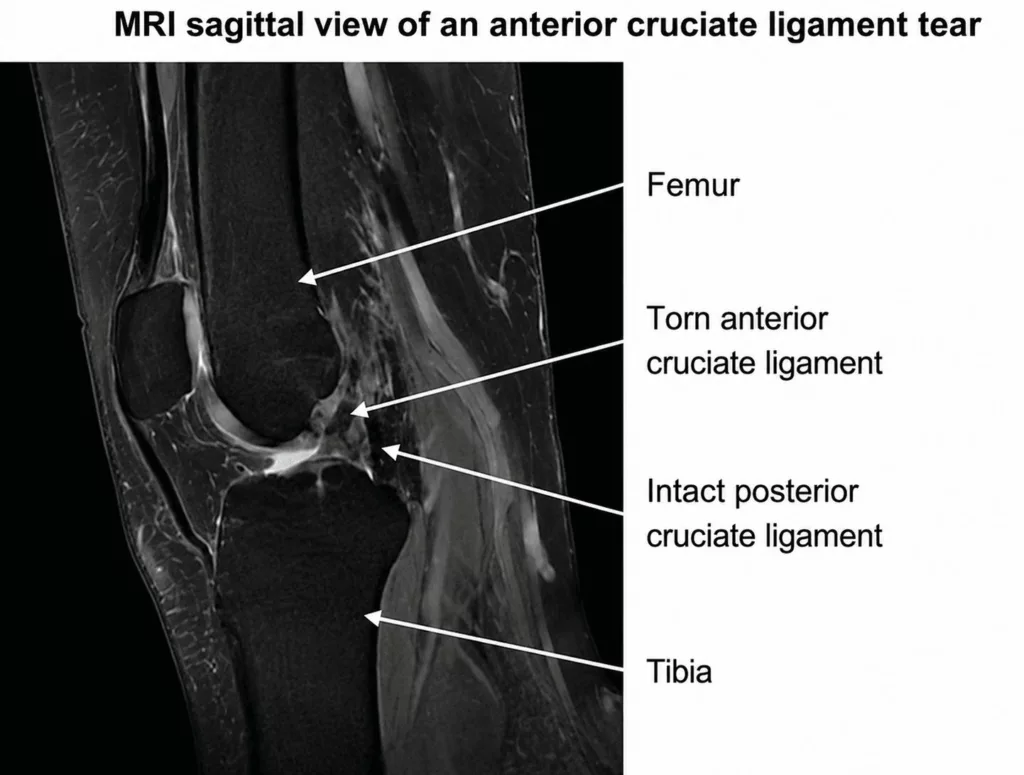
Imaging studies are routinely performed in addition to the clinical examination. Standard knee X-rays are obtained to identify associated injuries or indirect bony signs of ACL rupture. Magnetic resonance imaging (MRI) is the reference examination for confirming the diagnosis, allowing precise visualisation of the torn ligament while also assessing the menisci and the other ligaments of the knee.
Treatment of an Anterior Cruciate Ligament (ACL) Tear
During the initial acute and painful phase, treatment consists of immobilising the knee in a brace together with pain relief, anti-inflammatory medication, rest and regular application of ice. Symptoms generally improve over the following weeks as the swelling subsides and normal daily activities are gradually resumed.
However, the natural progression of an ACL tear remains unfavourable because the ligament is unable to heal on its own. Persistent instability may develop, affecting everyday activities and making movements such as pivoting or changing direction increasingly difficult. Returning to sporting activities may therefore become impossible without further treatment.
For patients wishing to restore knee stability and return to sport, ACL reconstruction surgery should be considered.