
Distal Femoral Varus Osteotomy in Hauts-de-Seine
Knee Surgery
What Is a Distal Femoral Varus Osteotomy?
Dr Simon Tournemine in Hauts-de-Seine (92)
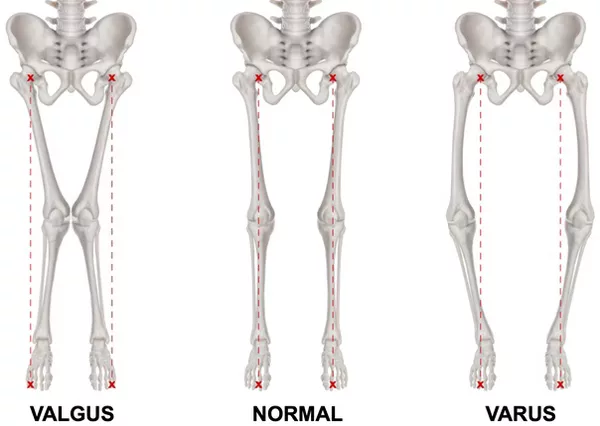
A distal femoral varus osteotomy (DFO) is a surgical procedure that involves cutting part of the femur to correct abnormal lower limb alignment. When the legs are misaligned in varus (bow-legged) or valgus (knock-kneed), mechanical forces are distributed unevenly across the knee. This abnormal loading can cause pain and contribute to progressive cartilage wear and knee osteoarthritis.
By restoring more appropriate alignment of the leg, the procedure redistributes mechanical forces more evenly across the knee joint. This may relieve pain, delay the progression of osteoarthritis and help preserve the joint for longer.
This surgery is particularly appropriate for patients under the age of 60 with moderate osteoarthritis. After the age of 65, a unicompartmental knee replacement (UKR) is more commonly considered.
Distal Femoral Varus Osteotomy Procedure
Knee Surgery Specialist in Hauts-de-Seine (92)
This procedure requires highly accurate correction of the lower limb alignment. A CT scan is therefore performed to create a three-dimensional reconstruction of the knee and prepare a personalised surgical plan. Patient-specific cutting guides are then manufactured to fit the anatomy of the knee precisely and achieve the required correction.
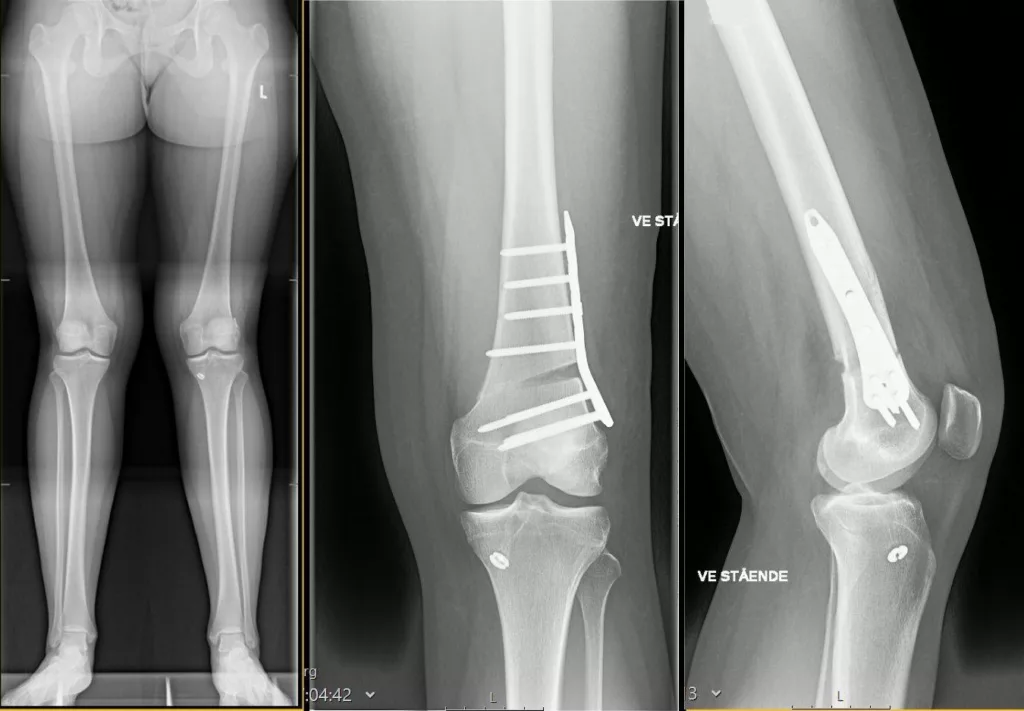
An incision measuring approximately 15 cm is made over the lower part of the femur to position the cutting guides and perform the planned bone cut. The osteotomy is then opened to realign the leg according to the preoperative plan.
The corrected position is stabilised using a metal plate and screws. The space created by opening the osteotomy is filled with a bone substitute to promote and accelerate bone healing.
The procedure generally lasts approximately 40 minutes.
It is performed under either general anaesthesia or spinal anaesthesia, in which only the lower limbs are anaesthetised. The choice of anaesthetic is made jointly with the anaesthetist during the preoperative consultation.
This procedure may be performed as day-case surgery, allowing the patient to return home on the same day, or may require one night in hospital.
Distal Femoral Varus Osteotomy in Rueil-Malmaison
Knee Surgery in Hauts-de-Seine
When Is a Distal Femoral Varus Osteotomy Recommended?
Knee osteoarthritis, also known as gonarthrosis, is a progressive degenerative condition characterised by wear of the joint. No treatment can reverse this degeneration, and the condition generally worsens over time.
Several conservative treatments may initially be prescribed to relieve pain, including lifestyle and dietary measures, pain-relieving medication, anti-inflammatory treatment and physiotherapy. When these treatments no longer provide sufficient relief and the condition interferes with everyday activities, a distal femoral osteotomy may be considered.
This procedure is effective in patients under the age of 65 with early-stage osteoarthritis. When osteoarthritis is too advanced, or in patients over the age of 65, a unicompartmental knee replacement is generally considered instead. This is why distal femoral osteotomy should be discussed relatively early in the course of the condition.
Other factors must also be considered, including the extent of the deformity, the presence of an associated ligament rupture, the patient’s activity level and their medical history.
The indication must therefore be assessed individually. A detailed discussion with your surgeon is necessary to determine whether a unicompartmental knee replacement or a distal femoral varus osteotomy is the most appropriate option.
Postoperative Rehabilitation After Distal Femoral Varus Osteotomy
Following surgery, the dressing is generally changed every two days for approximately two weeks. Pain management is closely monitored to maximise comfort and facilitate early rehabilitation. Anticoagulant treatment is prescribed for six weeks to reduce the risk of deep vein thrombosis.
After the operation, the knee is supported in a hinged brace. Walking is permitted using two crutches, with limited weight-bearing for six weeks.
Enhanced Recovery After Surgery (ERAS) protocols are used, and a physiotherapist assists patients with walking and beginning rehabilitation on the day of surgery. Early mobilisation combined with physiotherapy plays a key role in achieving a favourable recovery, as it helps preserve and improve muscle function and knee mobility.
Following discharge, your surgeon will provide all necessary prescriptions, including dressings, pain medication, anticoagulants and physiotherapy. Rehabilitation should continue either at home with a physiotherapist or in a rehabilitation centre. Early resumption of everyday activities forms an important part of recovery.
Driving is generally possible around six weeks after surgery. Sick leave also usually lasts approximately six weeks, although this depends on the patient’s occupation, and office-based work may often be resumed earlier.
Sporting activities may be reintroduced progressively from the third postoperative month. These timeframes are averages and are provided for guidance only, as recovery varies from one patient to another.
Long-term clinical and radiographic follow-up remains essential to monitor the knee and identify any potential abnormalities.
Risks and Complications of Distal Femoral Varus Osteotomy
Every precaution is taken to promote a favourable recovery. Nevertheless, as with any surgical procedure, complications, although uncommon, may occur.
The principal risks include:
- Deep vein thrombosis and pulmonary embolism: uncommon complications, with the risk reduced by anticoagulant treatment prescribed after surgery;
- Worsening of a pre-existing medical condition: such as heart failure or diabetes. Postoperative monitoring by the anaesthetic team is provided to reduce this risk;
- Infection, with a risk below 1%: this may require further surgery to wash out the surgical site, followed by antibiotic treatment. As smoking significantly increases the risk of infection and wound-healing complications, patients are strongly advised to stop smoking at least one month before surgery and for three months afterwards;
- Reduced knee mobility and postoperative stiffness: these may develop if rehabilitation is not carried out appropriately;
- Haematoma: postoperative bleeding may lead to the formation of a haematoma. Depending on its severity, drainage or blood transfusion may be required;
- Sensory nerve injury: small sensory nerve branches around the knee may rarely be injured, resulting in reduced sensation over certain areas of the knee;
- Non-union: failure of the osteotomy to heal is an uncommon complication that may require further surgery to stimulate bone healing;
- Complex Regional Pain Syndrome (CRPS): a painful and inflammatory condition that remains poorly understood. It is treated medically and may persist for several months or, in some cases, several years. It may require adapted rehabilitation, additional investigations and specific pain management. Its onset, progression and possible long-term consequences are unpredictable;
- Injury to the tibial or common peroneal nerve: this is a very rare complication in this type of osteotomy. It may occur following a haematoma, surgical trauma or a reaction to regional anaesthesia. Recovery may occur over several months in some cases;
- Injury to the blood vessels of the leg: this is extremely rare but may require an additional procedure or urgent further surgery to restore blood flow to the limb;
- Compartment syndrome: this is an increase in pressure within the leg, most often caused by a haematoma, which impairs the local microcirculation and requires urgent surgical decompression.
These are the principal risks associated with distal femoral varus osteotomy, but the list is not exhaustive. Other exceptional complications may occur. Not every possible complication can be specified. Your surgeon remains available to discuss the particular risks associated with your individual situation.
Results of Distal Femoral Varus Osteotomy
The natural progression of osteoarthritis in a malaligned knee is unfavourable. The deformity gradually worsens and the condition of the knee deteriorates, with the development of meniscal, cartilage and osteoarthritic lesions that may ultimately require knee replacement surgery.
Distal femoral varus osteotomy has two principal objectives:
- To realign the knee, relieve pain and instability, and allow a return to sporting activities;
- To redistribute mechanical forces more evenly across the knee and slow long-term joint wear.
Patient-specific 3D planning allows highly accurate correction, with very good results achieved in the majority of cases.
The osteotomy generally allows patients to resume their personal, professional and sporting activities progressively after approximately six weeks.
Once recovery and bone healing are complete, all sporting activities may be resumed without restriction.