
Patellar Tendon Debridement in Hauts-de-Seine
Knee Surgery
What Is Patellar Tendon Debridement?
Dr Simon Tournemine in Hauts-de-Seine (92)
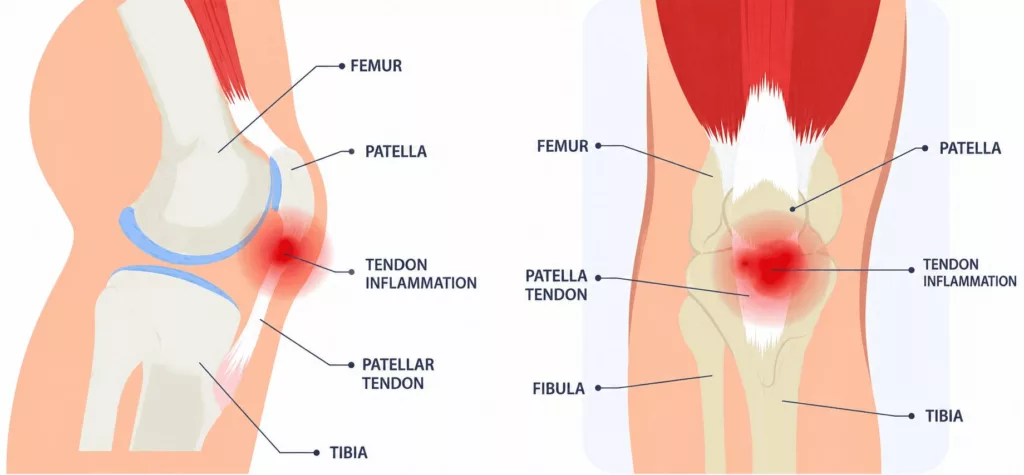
The knee joint is formed by three bones: the patella (kneecap), the tibia and the femur. Knee extension is produced by the extensor mechanism, which is driven by the quadriceps muscle. When the quadriceps contracts, it pulls on the patella, which is itself attached to the tibia through the patellar tendon. As a result, the patellar tendon is subjected to considerable mechanical stress.
Patellar tendinopathy is caused by the accumulation of repeated microscopic injuries within the tendon between the patella and the tibia. Repetitive overuse of the knee can produce tiny tears within the tendon. The body attempts to repair these injuries, resulting in local inflammation. When this inflammatory process persists over time, chronic patellar tendinopathy develops.
Patellar Tendon Debridement Procedure
Knee Surgery Specialist in Hauts-de-Seine (92)
Patellar tendon debridement consists of making multiple longitudinal incisions along the direction of the tendon fibres using a scalpel. Damaged tendon fibres, nodules and symptomatic calcifications responsible for the tendinopathy are also removed.
The aim of the procedure is to restore healthy tendon tissue while stimulating the natural healing process, allowing the tendon to become stronger. To perform this operation, an incision of approximately 8 cm is made over the front of the knee.
The procedure is relatively short, lasting approximately 20 minutes.
It is performed under either general anaesthesia or spinal anaesthesia, during which only the lower limbs are anaesthetised. The choice of anaesthetic is made jointly with the anaesthetist during the preoperative consultation.
This operation is performed as day-case surgery, allowing patients to return home on the same day.
Patellar Tendon Debridement in Rueil-Malmaison
Knee Surgery in Hauts-de-Seine
Postoperative Care and Rehabilitation After Patellar Tendon Debridement
The dressing is usually changed every two days for approximately two weeks. Pain management is carefully monitored to maximise comfort and facilitate early rehabilitation. Anticoagulant medication is prescribed for two weeks to reduce the risk of deep vein thrombosis.
Walking is permitted on the day of surgery with full weight-bearing while wearing a knee brace that maintains the knee in full extension for approximately three weeks. This protects the tendon while it heals.
Physiotherapy begins immediately after surgery to preserve muscle strength and maintain knee flexibility.
Driving is generally possible after three weeks, while sporting activities may usually be resumed after approximately six weeks.
These recovery times are average estimates and may vary between individuals.
Long-term clinical and radiographic follow-up remains essential to monitor the knee and detect any potential abnormalities.
When Is Patellar Tendon Debridement Recommended?
Patellar tendinopathy is initially managed with conservative treatment. This includes resting the knee and taking anti-inflammatory medication.
Corticosteroid injections are not recommended, as they may weaken the tendon and increase the risk of rupture.
Contributing factors should also be addressed, including appropriate footwear, limiting alcohol and tobacco consumption, maintaining good hydration, and performing regular stretching and strengthening exercises when returning to sporting activities.
When conservative treatment fails to relieve symptoms and pain continues to limit daily life or sporting activities, patellar tendon debridement may be considered.
Why Undergo Patellar Tendon Debridement? What Are the Benefits?
This procedure has two main objectives:
- To remove damaged tissue and strengthen the tendon, relieving pain and allowing a return to sporting activities.
- To reinforce the tendon, reducing further degeneration and lowering the long-term risk of tendon rupture.
The procedure generally provides rapid pain relief and enables patients to return to sport.
Risks and Complications of Patellar Tendon Debridement
Every precaution is taken to promote a successful recovery. Nevertheless, as with any surgical procedure, complications, although uncommon, may occur.
The principal risks include:
- Deep vein thrombosis and pulmonary embolism: uncommon complications, with the risk reduced by anticoagulant treatment prescribed for two weeks after surgery;
- Worsening of a pre-existing medical condition: such as heart failure or diabetes. Postoperative monitoring by the anaesthetic team is provided to minimise this risk;
- Infection, with a risk below 1%: this may require further surgery to clean the operative site, followed by antibiotic treatment;
- Reduced knee mobility and postoperative stiffness: these may occur if rehabilitation is not performed appropriately;
- Haematoma: postoperative bleeding may lead to the formation of a haematoma. Depending on its severity, drainage or blood transfusion may be required;
- Sensory nerve injury: small sensory nerve branches supplying the knee may rarely be injured, resulting in reduced sensation over certain areas of the knee;
- Patellar tendon rupture: during the first three postoperative weeks the tendon remains vulnerable. Failure to comply with the brace or rehabilitation protocol may increase the risk of tendon rupture;
- Complex Regional Pain Syndrome (CRPS): a painful and inflammatory condition that remains poorly understood. It is treated medically and may persist for several months or, in some cases, several years. It may require adapted rehabilitation, additional investigations and specialist pain management. Its onset, progression and potential long-term consequences are unpredictable.
These are the principal risks associated with the procedure, but the list is not exhaustive. Other exceptional complications may occur. Not every possible complication can be specified. Your surgeon remains available to discuss the particular risks associated with your individual situation.
Results of Patellar Tendon Debridement
Approximately 80% of patients experience significant pain improvement following patellar tendon debridement.
A return to sporting activities without pain is possible in the great majority of cases. Recovery of knee strength and full mobility generally occurs within two to three months.