
Hallux valgus surgery should be performed neither too early nor too late. If the deformity does not cause significant symptoms in everyday life, conservative treatment is usually sufficient. However, when daily pain develops or the deformity becomes severe and affects the other toes, surgical correction becomes necessary.
What is hallux valgus?
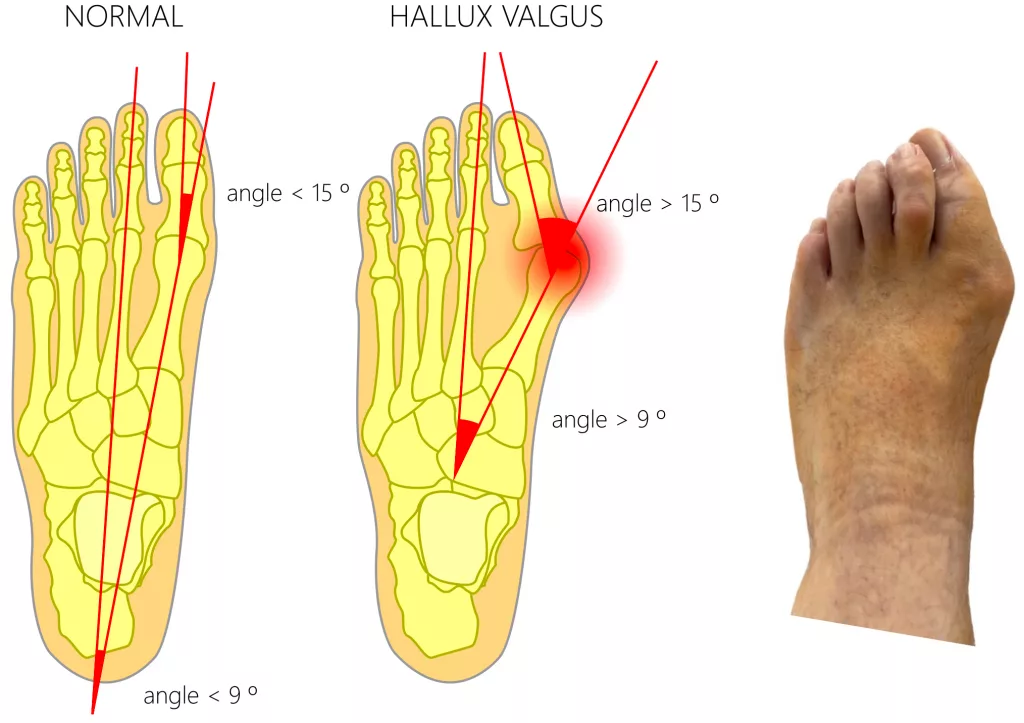
Hallux valgus is a common foot condition characterised by a deviation of the great toe towards the other toes. This deviation is associated with a deformity of the first metatarsophalangeal joint, leading to the formation of a painful bunion on the inner side of the foot.
Hallux valgus has several causes. Wearing unsuitable footwear or having a particular foot shape, such as flat feet, may increase the risk of developing the condition.
What are the complications of hallux valgus?
If left untreated, hallux valgus may lead to a number of complications, including:
- Difficulty wearing shoes;
- An increased risk of infection;
- Claw toe deformity of the second toe;
- Osteoarthritis of the great toe;
- Walking and balance disorders.
What preventive measures can help avoid surgery?
Simple preventive measures may slow the progression of hallux valgus and, in some cases, help delay or avoid surgery. An assessment by a specialist is recommended.
- Avoid high-heeled shoes. This type of footwear compresses the toes and promotes progression of the deformity. Shoes with a low heel and a wide toe box are preferable.
- Treat skin inflammation and calluses caused by hallux valgus with the help of a podiatrist.
- Wear custom orthotic insoles. These support the arch of the foot and reduce pressure beneath the great toe.
When should hallux valgus be treated surgically?
Hallux valgus surgery should be performed neither too early nor too late. If there is no pain and the deformity is not disabling, conservative treatment is preferred, including wearing wide shoes, using orthotic insoles and receiving routine podiatric care.
However, surgery should be considered when daily pain, deformity of the other toes or walking difficulties develop. The aim of the procedure is to correct the alignment of the bones responsible for the deformity.
What does hallux valgus surgery involve?
Several surgical techniques may be recommended depending on the type and severity of the deformity.
Open SCARF osteotomy
An incision of approximately 7 cm is made along the inner side of the foot. The first metatarsal and the proximal phalanx of the great toe are then cut and realigned. Tight soft tissues are also released, including contracted tendons, ligaments and adhesions.
The repositioned bone fragments are fixed using one or two screws, which are usually left in place permanently. However, if they become symptomatic, they can be removed.
Percutaneous osteotomy
An alternative technique involves making very small incisions using a minimally invasive or percutaneous approach, performed under fluoroscopic guidance. The corrected bones are stabilised with a screw or, in some cases, maintained solely with a postoperative dressing.
The choice between these two techniques should be discussed with your surgeon and depends on both the type and the severity of the deformity.
At what age can hallux valgus surgery be performed?
There is no specific age limit for hallux valgus surgery. Early forms of the condition may be treated from adolescence onwards.
Later-onset hallux valgus can also be treated surgically without an upper age limit, provided the patient’s general health allows the procedure to be performed.